Boat Storage Insurance in Florida: What to Check
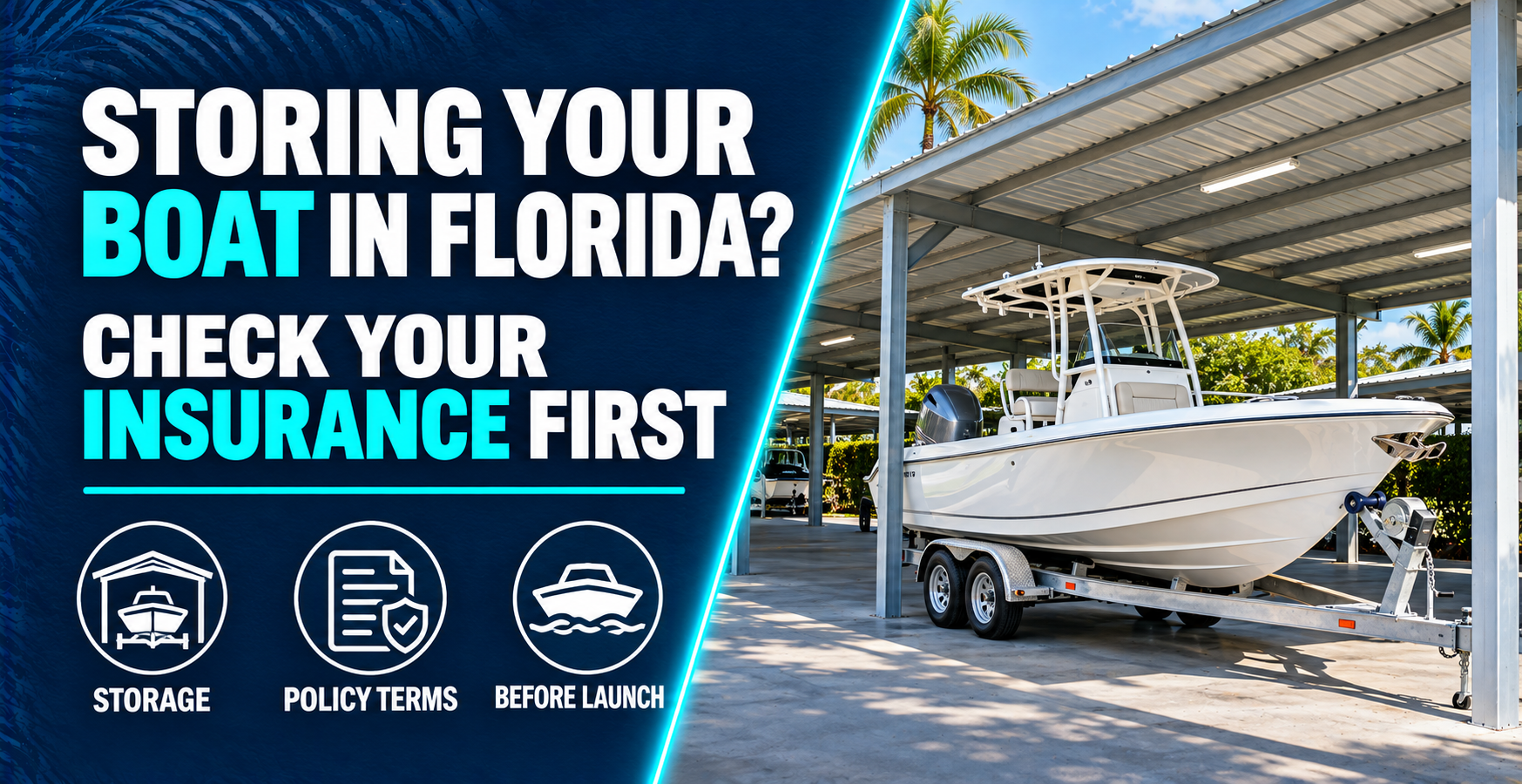
Storing Your Boat in Florida? Review Your Insurance Before You Change Coverage
The Direct Answer
Putting a boat in storage does not eliminate the need to review its insurance. Before canceling or reducing coverage, check what protects the vessel while parked, whether a lender or storage agreement requires insurance, and whether your policy limits when or where you may operate it. Storage arrangements and insurance terms should match your actual plans. Ask for confirmation of any requested change and its effective date; a boat being out of the water does not, by itself, tell you what a policy covers.
Perhaps you are leaving Stuart for several months, parking a fishing boat at home, or moving a center console into covered storage. The practical question is what happens between your last trip and your next launch. Build that review around the boat’s location, the documents you signed and the protection you want to keep.
1. Separate the Storage Plan from the Insurance Plan
Start with a written description of your arrangement: the storage address, expected dates, whether the boat stays on a trailer or rack, and who can move it. Include any plans to take an occasional trip. “Stored for the season” is less useful than a clear description of what will actually happen.
Identify the coverage you have now. Liability addresses a different exposure from damage to your own vessel. For example, Progressive describes comprehensive boat coverage as protection against specified non-collision events such as theft, fire and weather damage, subject to the deductible and policy terms. That is a carrier example, not confirmation that every Walker client has the same coverage. [1]
Illustrative scenario: You put your boat in a covered storage space and later discover damage after an incident nearby. The roof over the boat does not answer the coverage question. Your review should identify the selected protection, applicable deductible and relevant exclusions before a loss occurs.
Check separate items, too. Ask how the policy treats the trailer, outboard motor, installed electronics and portable fishing gear. Progressive lists optional protection for certain fishing equipment and carry-on belongings, illustrating why you should not assume every item is treated as part of the hull. [1] Prepare a short equipment list so the conversation is specific.
2. Read the Loan, Storage Agreement and Policy Together
A storage decision involves more than the premium. Progressive notes that a lender or marina may require continuing insurance even when a boat is not being used. [2] Read your own agreement instead of assuming another boater’s requirements apply to you.
Illustrative scenario: You own the boat outright and plan to cancel its policy after moving it into a facility. Before acting, read the facility’s insurance clause. Ask which limits it requests, what evidence it needs and whether it requires anything beyond a certificate. Send the actual wording to your agency rather than relying on a verbal summary.
Likewise, do not treat a facility’s statement that it is “insured” as a complete explanation of your boat’s protection. Ask who is insured, which property is addressed, and how a claim involving a customer’s vessel would be handled. Your own boat policy and a storage business’s policy are separate contracts; obtain the relevant documentation rather than guessing about either one.
Ask your agency to identify any operating dates, storage conditions or navigation restrictions in your policy. If the document uses a term such as “lay-up,” have the agency explain that wording and what you must do before changing your plans. This is a question about your contract, not a rule that every Florida boat policy uses the same seasonal restriction.
3. Document Storage and Plan the Return to the Water
Take dated photographs of the hull, motor, trailer and equipment before handoff. Keep the storage agreement, equipment inventory, relevant maintenance receipts and insurance documents together. This creates a record of the arrangement and condition; it does not establish that a future claim will be covered.
Insurance and maintenance should be reviewed separately. Progressive’s winterizing guidance recommends following manufacturer instructions even in warmer climates and using professional help when needed. [3] Have the appropriate marine professional prepare a maintenance plan for your vessel rather than assuming an insurance change replaces physical preparation.
Illustrative scenario: You originally planned three months of storage, but relatives visit and you want a weekend on the water. Before launch, check whether your current policy permits the trip. If a change is needed, confirm acceptance, its effective date and any remaining restrictions. An email requesting a change is not the same as confirmation that it took effect.
Keep a return-to-use checklist: review the storage dates, confirm the intended boating area, verify the policy remains active, and ask whether any requested adjustments are documented. Pair that insurance check with the vessel’s separate safety and maintenance inspection.
Why an Independent Agency Conversation Helps
An independent-agency comparison is most useful when it considers contract terms alongside price. Two proposals should be checked against the same storage address, equipment description and intended use. Otherwise, an apparent savings may reflect a different selection of protection rather than a comparable option.
Walker’s boat insurance service page explains that vessel type and boating habits affect coverage needs and describes differing claim-value approaches. Start with Walker’s boat insurance services to discuss your own arrangement. The agency’s public site also provides access to multiple insurance providers; availability for a particular boat or storage plan must be confirmed. [4]
Questions to Bring to Walker
Bring your current policy and ask: Which selected coverages remain relevant during storage? Are the trailer and equipment addressed? Does the storage agreement require a change? What must happen before an early launch? Request a comparison that names the relevant limits, deductibles and restrictions rather than focusing on one total premium.
FAQ
1. Can I cancel my boat insurance while it is stored?
Ask about the consequences before canceling. You would be removing the protection provided by that policy, and your own loan or storage agreement may require it to continue. Consider the proposed cancellation date alongside those documents and your remaining exposure. A temporary pause in boating is a reason to review the policy, not an automatic instruction to cancel. [2]
2. Is equipment automatically included with the boat?
Do not assume that installed equipment, portable belongings and the trailer share one coverage treatment. Identify each item and ask where it appears in the policy. Check optional coverages and limits before deciding what to leave aboard. Keep photos and receipts as useful documentation, while recognizing that records do not expand the insurance contract. [1]
3. What should I confirm before using the boat again?
Confirm the policy’s status, any applicable use restrictions and the effective date of accepted changes. Tell the agency if your launch date, location or intended boating area differs from the original plan. Ask for the relevant updated documents, then complete the separate maintenance and safety checks required for your vessel.
Review Your Storage Plan Before You Put the Boat Away
A clear plan makes it easier to compare the protection you have with the arrangement you are about to use. Contact Walker Insurance Agency with your policy, storage agreement and expected launch date to discuss your boat insurance options.
REQUEST A BOAT INSURANCE QUOTE
Call +1 407-977-7100 or visit 789 SW Federal Highway, Suite 201, Stuart, FL 34994. You can also use Walker’s contact page. Coverage depends on the issued policy, selected options, exclusions, limits and deductibles. A quote request does not bind or change insurance.
Sources
[1] Progressive — Boat Insurance Coverages: https://www.progressive.com/boat/coverages/
[2] Progressive — Do You Need Boat Insurance in the Winter?: https://www.progressive.com/answers/boat-insurance-in-the-winter/
[3] Progressive Life Lanes — How to Winterize a Boat: https://lifelanes.progressive.com/winterizing-a-boat/
[4] Walker Insurance Agency — Boat Insurance: https://www.walkerinsuranceagency.com/services/boat-insurance
Contact and quote information: https://www.walkerinsuranceagency.com/ | https://www.walkerinsuranceagency.com/contact | https://www.walkerinsuranceagency.com/quote
Related Articles
Reembolso de Auto de Alquiler en Florida: Qué Revisar
¿Tu auto está en reparación por un siniestro cubierto? Revisa límites de reembolso, forma de pago y cargos antes de reservar un auto de alquiler en Florida.
Read More →
Rental Reimbursement in Florida: What to Check
Car in the shop after a covered claim? Review rental reimbursement limits, payment arrangements and rental charges before booking a replacement vehicle in Florida.
Read More →
Seguro de Embarcación Guardada en Florida: Qué Revisar
¿Guardarás tu embarcación en Florida? Revisa coberturas, requisitos del préstamo y del almacén, restricciones de la póliza y pasos antes de volver a navegar.
Read More →