Does Homeowners Insurance Pay for Temporary Housing Indefinitely? (2026)
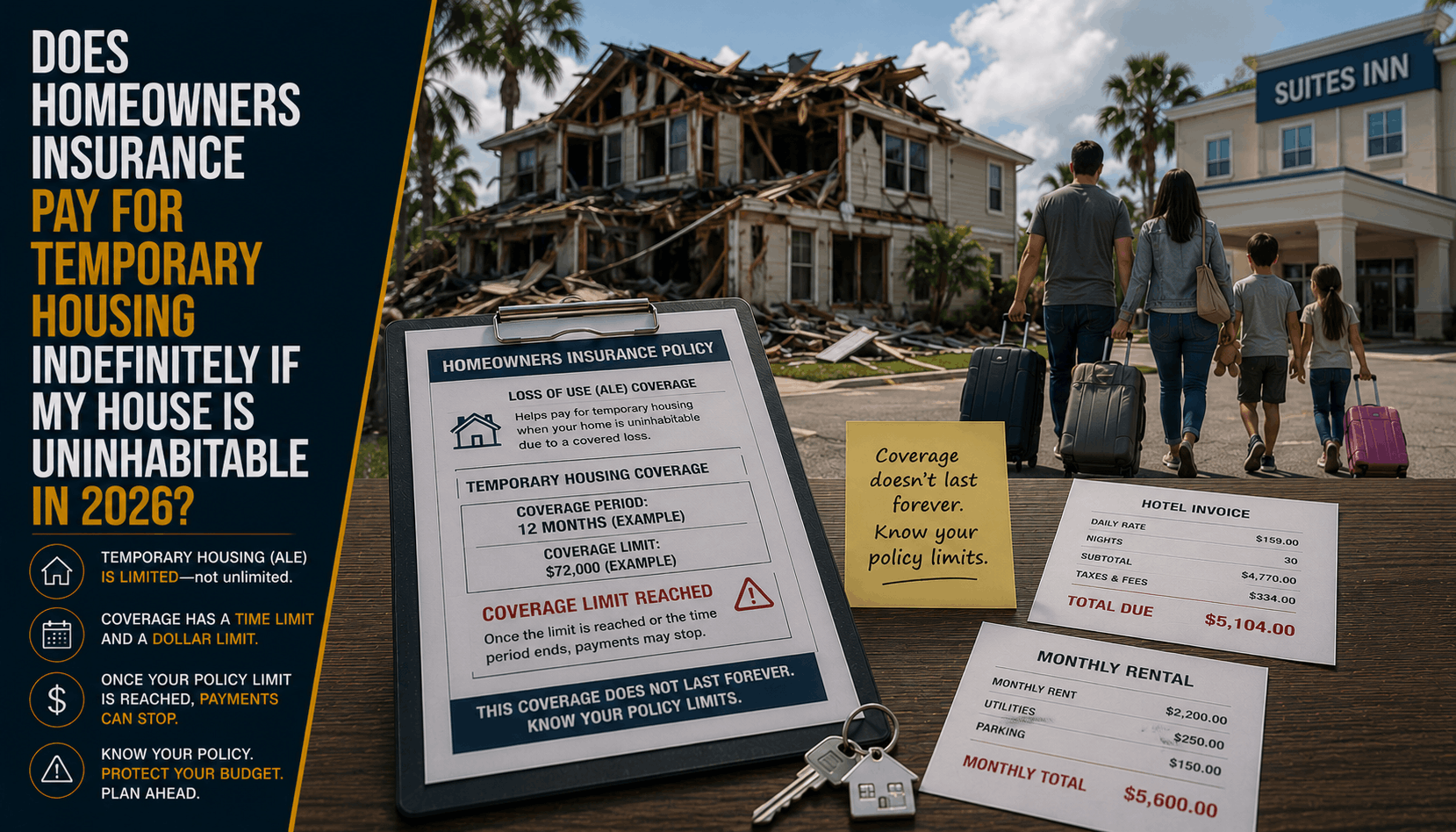
Does Homeowners Insurance Pay for Temporary Housing Indefinitely If My House Is Uninhabitable in 2026?
The Direct Answer
The short answer is no, homeowners insurance will never pay for temporary housing indefinitely. If a fire, severe storm, or covered disaster leaves your home unlivable, your policy's Loss of Use coverage (also called Coverage D or Additional Living Expenses / ALE) provides vital financial help for rent, hotel stays, and displaced living costs. However, insurers strictly cap these benefits using two legal boundaries: a financial maximum and a time limitation. Financially, Coverage D is usually capped at 10% to 30% of your total Dwelling Coverage limit. Temporally, standard policies restrict payouts to the "shortest time required to repair or rebuild" or impose a hard cutoff at 12 to 24 months. Once you hit either your dollar limit or your time cap—whichever comes first—insurance payments stop immediately. In 2026, with construction delays and labor shortages stretching rebuilds past 18 months, running out of temporary housing coverage before your home is finished is a very real financial threat.
SmartFinancial+ 2
Relying on temporary relocation coverage without checking your contract parameters can result in paying double housing costs mid-rebuild. Understanding how these policy boundaries function—and how to expand them—is essential for every homeowner.
1. The Two Legal Caps on Temporary Housing Benefits
Insurance companies bound Loss of Use payments with strict contractual parameters. Your rent and living allowances will cease as soon as your claim triggers either limit:
- The Financial Limit (Percentage of Dwelling Coverage): Most standard policies calculate your Maximum Additional Living Expense limit as a percentage of your total Dwelling Coverage (Coverage A), usually 20% to 30%. For instance, if your dwelling is insured for $500,000, your maximum Loss of Use fund is $100,000 to $150,000. High monthly rents in competitive markets can burn through this pool quickly.
SmartFinancial - The Time Cutoff (12-to-24 Month Limits): Many policies include an explicit calendar limitation. Even if you have remaining funds in your dollar allowance, temporary housing payments terminate after 12, 18, or 24 months depending on your policy wording and state insurance regulations.
- The "Shortest Time Required" Clause: Insurance contracts require policyholders to proceed with repairs using "reasonable diligence." If an insurer decides construction delays are due to your inaction, they can legally cut off payments early.
2. Why Temporary Housing Coverage Runs Out in 2026
While insurance guidelines were drafted around standard 6-to-12-month construction windows, modern economic and regulatory realities frequently stretch major home reconstructions well past a year:
Permitting backlogs at municipal building offices regularly stall projects for months before site preparation even begins. High demand for licensed general contractors and specialized sub-contractors creates extended project delays.
Furthermore, upgrading a damaged property to satisfy modern municipal building codes (such as updated electrical systems or elevation requirements) requires additional engineering approvals and construction time. When major regional disasters or severe storms hit, local labor and material markets experience severe supply bottlenecks, pushing rebuild timelines to 18–24 months or longer.
Crucial Financial Reality: While displaced from your home, you remain fully responsible for your baseline housing expenses—including your primary mortgage, property taxes, and home equity payments—even if insurance housing funds run out.
NAIC
3. How to Protect Yourself from Running Out of Coverage
To keep your temporary housing funds flowing until construction is complete, take these proactive measures:
- Step 1: Increase Your Coverage D Percentage. When reviewing your policy, ask your provider to increase your Loss of Use limit from the standard 20% to 30% or 50% of your Dwelling Coverage.
- Step 2: Add an Extended Loss of Use Endorsement. Look for policy add-ons or endorsements that extend the time cap from 12 months to 24 months (or remove the time limit altogether, making it governed solely by your total dollar limit).
- Step 3: Document Construction Timelines Meticulously. Keep detailed logs of all municipal permit applications, contractor communications, and supply delivery schedules. Demonstrating that delays are outside your control helps justify continued ALE disbursements up to your policy limit.
California Department of Insurance - Step 4: Track Excess Living Costs. Loss of Use reimburses expenses above your normal cost of living. Maintain organized receipts for rent, excess mileage, restaurant dining (if staying in a unit without a kitchen), and pet boarding.
NAIC
Why Working with an Independent Agency Is Vital
Managing catastrophic property claims and understanding policy exclusions requires experienced professional guidance. At Walker Insurance Agency, we help you structure comprehensive home coverage to prevent unexpected shortfalls during a major recovery.
The Walker Advantage:
- Policy Limit Audits: We analyze your Loss of Use caps, dwelling replacement coverage, and endorsement options to eliminate hidden time or financial traps.
- Tailored Coverage Solutions: We match your policy limits to local rental market costs and actual reconstruction timelines in your area.
- Dedicated Claims Advocacy: If disaster strikes, our team assists you in navigating the claims process, coordinating with adjusters, and protecting your living expense reimbursements.
FAQ
1. Does Loss of Use cover my monthly mortgage payment?
No. Insurance does not pay your mortgage. Loss of Use is designed to cover additional living costs created by the displacement—such as temporary apartment rent—above your normal baseline mortgage and housing obligations.
SmartFinancial+ 1
2. What happens if my rebuild is delayed by government or civil orders?
If a civil authority blocks access to your neighborhood due to safety hazards (such as wildfire threats or structural collapses), Loss of Use coverage generally provides temporary living expense coverage for up to two weeks, subject to policy terms.
American Family Insurance
3. Can I receive an upfront advance on temporary living expenses?
Yes. Many insurers offer an initial advance payment on Loss of Use coverage to pay for immediate hotel stays, security deposits, or emergency supplies while your full claim is being processed.
Secure Your Family's Temporary Housing Protection Today
A major property loss is difficult enough without facing the sudden loss of temporary housing support mid-rebuild. Checking your policy limits today ensures your family remains securely housed until you can safely move back home.
Take charge of your homeowners insurance coverage today. Contact Walker Insurance Agency for a thorough policy review. We offer the professional insight needed to close coverage gaps, optimize policy limits, and safeguard your home and financial stability.
[GET A FREE QUOTE TODAY]
Call our personal lines division at +1-407-977-7100 or visit our office in Stuart, FL. Let us safeguard your property boundaries today.
Related Articles

¿Cubre el Seguro Hundimientos de Tierra o Grietas en Florida? (2026)
¿Aparecieron grietas en tus paredes o cimientos tras las lluvias en Florida? Descubre la diferencia entre Sinkholes y Catastrophic Ground Collapse en 2026.
Read More →
Found Cracks After Heavy Florida Rains? Sinkhole Coverage Rider 2026
Found cracks in your walls or foundation after Florida storms? Learn why standard home insurance denies sinkhole claims and why you need a sinkhole rider.
Read More →
¿Cubre el Seguro los Códigos de Construcción en Florida en 2026?
¿Vas a reconstruir tu casa tras un huracán en Florida? Descubre por qué los códigos de construcción pueden costarte $50,000 y cómo la cobertura Ordinance or Law te salva.
Read More →