Does Insurance Pay for Lost Resale Value After a Crash? (2026)
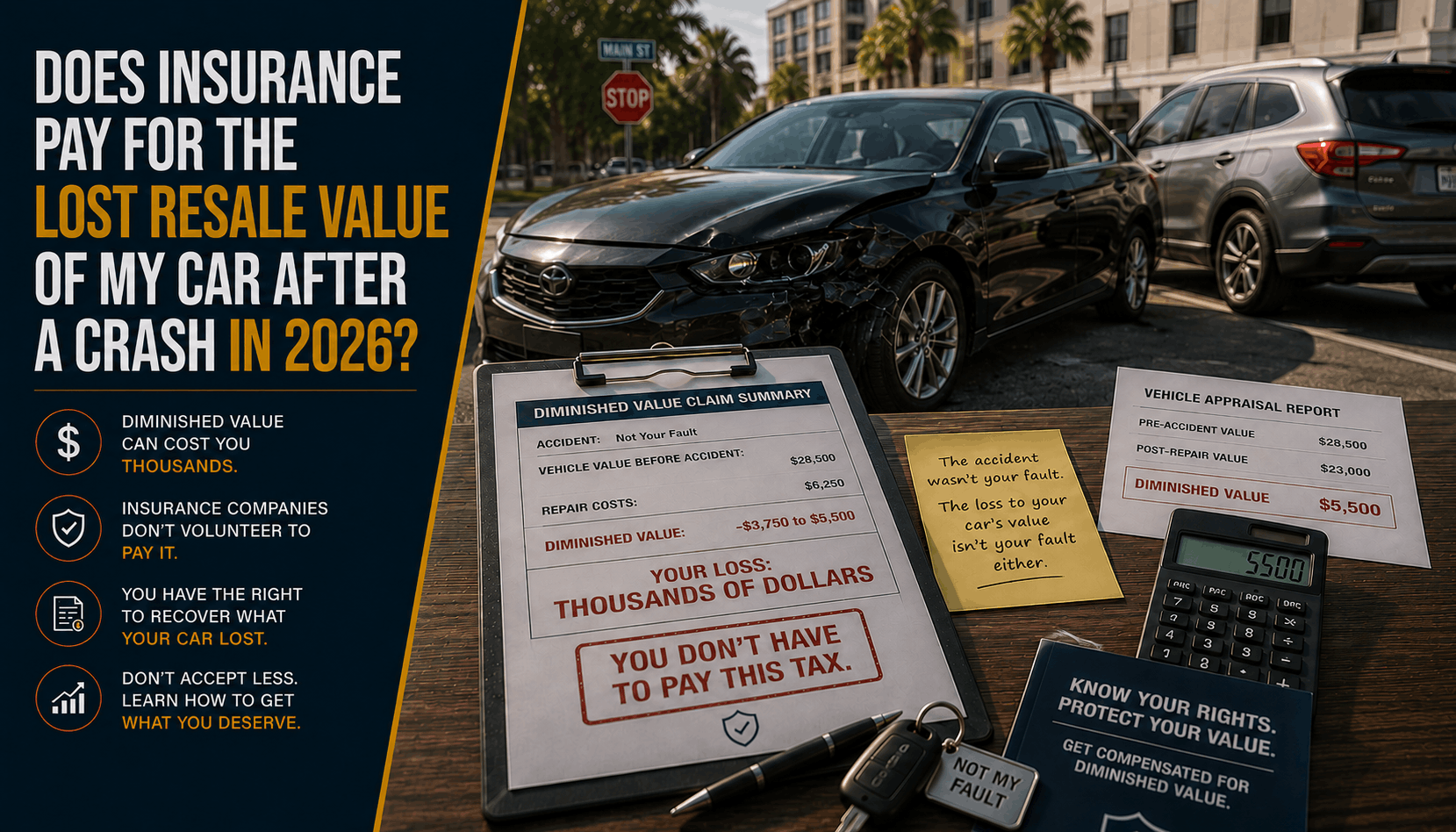
Does Insurance Pay for the Lost Resale Value of My Car After a Crash in 2026?
The Direct Answer
The short answer is yes, but almost exclusively through a third-party claim against the at-fault driver’s insurance company. Standard auto insurance will not automatically write you a check for your vehicle’s post-crash loss in market value. Even when body shops perform flawless repairs, a vehicle with a recorded crash history on CARFAX or AutoCheck typically suffers a 10% to 30% drop in resale value compared to an identical vehicle with a clean history. This financial loss is known as Inherent Diminished Value. If another driver caused the collision, their property damage liability policy is legally responsible for compensating you for this lost market value under third-party tort law. However, if you caused the accident or are filing solely through your own standard collision coverage (a first-party claim), auto insurance policies almost universally exclude inherent diminished value—meaning you cannot recover the lost resale value from your own insurer unless specific state mandates or uninsured motorist endorsements apply.
Relying solely on physical body repairs can quietly wipe out thousands of dollars of your car's equity. Understanding when and how insurance carriers compensate for lost resale value in 2026 is critical to protecting your investment.
1. First-Party vs. Third-Party Claims: Who Pays for Lost Resale Value?
Whether insurance pays for your vehicle's lost market value depends entirely on who was at fault and which insurance policy you file against:
- Third-Party Claims (At-Fault Driver's Insurance): If another driver hits your vehicle, their insurance company is legally bound under state tort liability laws to restore your overall financial position. This means paying for both physical repair bills and compensating you for the lost resale value (Inherent Diminished Value) caused by the recorded crash record.
- First-Party Claims (Your Own Policy): If you caused the accident or filed a claim under your own Comprehensive or Collision coverage, your standard auto policy contract explicitly excludes inherent diminished value. Insurers are only obligated to repair the vehicle to "pre-accident physical condition," not compensate for market stigma.
- The Uninsured/Underinsured Motorist Exception: If an uninsured driver hits your vehicle, certain states allow you to recover diminished value through your own Uninsured Motorist Property Damage (UMPD) coverage.
2. Market Behavior & Vehicle Impact in 2026
In 2026, as auto supply normalizes and used car depreciation patterns tighten, car buyers and dealerships are scrutinizing vehicle history reports more strictly than ever. Market data shows that diminished value impact varies heavily depending on the vehicle segment.
For Electric Vehicles (EVs), the typical diminished value loss range falls between 18% and 30%, driven by extremely high market stigma and buyer concerns regarding battery integrity and long-term repair quality. Luxury sedans experience a loss range between 15% and 25%, as buyers in this tier expect pristine title histories. Premium SUVs suffer a drop between 12% and 22% due to high resale expectations. High-trim pickup trucks generally see a 10% to 18% loss, balancing durability needs with premium features. Finally, mid-size and economy cars experience a moderate loss range between 6% and 14%, aligned with standard market depreciation sensitivity.
Key Takeaway: Insurance adjusters frequently try to apply generic caps (like the 17c formula) that limit lost value payouts to 10%. In reality, high-value segments like EVs and luxury vehicles experience significantly higher resale losses in today's market.
3. How to File and Prove a Diminished Value Claim
To collect a fair payout for lost resale value from the at-fault driver's insurance company, follow these steps:
- Step 1: Wait Until Body Repairs Are 100% Complete. Do not attempt to negotiate diminished value until all physical damage has been fully repaired by a certified body shop.
- Step 2: Do Not Sign a "Full & Final Release." When accepting a check for physical repairs, ensure you do not sign a liability waiver that forfeits your right to file a separate third-party property damage claim for diminished value.
- Step 3: Hire an Independent Certified Appraiser. A generic online trade-in estimate is rarely accepted by adjusters. An independent, local diminished value appraisal provides concrete market data and expert verification.
- Step 4: Submit a Formal Demand Package. Send a written demand letter to the at-fault driver’s insurance adjuster along with your independent appraisal, repair invoices, pre-accident history report, and photographs.
Why Working with an Independent Agency Is Vital
Navigating auto claims, liability disputes, and policy exclusions requires expert advisory. At Walker Insurance Agency, we help you structure your personal auto portfolio to protect your financial security on and off the road.
The Walker Advantage:
- Policy Structure Audits: We evaluate your coverage limits, collision options, and uninsured motorist endorsements to ensure robust protection against uncompensated losses.
- Claims Guidance & Advocacy: If you are involved in a crash, our local team provides step-by-step guidance on how to navigate third-party claims and deal effectively with insurance adjusters.
- Tailored Coverage Solutions: We review your vehicle portfolio, financing terms, and usage patterns to deliver optimal protection at competitive rates.
FAQ
1. Will my insurance premium go up if I file a third-party diminished value claim?
No. Because a third-party diminished value claim is filed directly against the at-fault driver's insurance policy, it does not count as a claim on your insurance record and will not affect your premium.
2. Is there a time limit to file a claim for lost resale value?
Yes. Diminished value claims fall under your state’s statute of limitations for property damage claims, which typically range from 2 to 4 years from the date of the accident. However, starting the process immediately after physical repairs are finished yields the strongest results.
3. Can I claim lost resale value on an older or high-mileage vehicle?
While technically possible, diminished value claims are hardest to recover on vehicles older than 7 to 10 years or with over 100,000 miles. The strongest claims are for newer vehicles (under 5 years old), low mileage, clean prior history, and significant repair costs exceeding $2,000.
Protect Your Car's Financial Value Today
A collision doesn't just damage metal and plastic—it leaves a permanent mark on your vehicle's financial record. Understanding your rights to recover lost resale value ensures you aren't left paying the price for an accident someone else caused.
Take control of your auto insurance strategy today. Contact Walker Insurance Agency for a comprehensive policy audit. We provide the technical expertise you need to close coverage gaps, navigate complex property claims, and safeguard your personal wealth.
[GET A FREE QUOTE TODAY]
Call our personal lines division at +1-407-977-7100 or visit our office in Stuart, FL. Let us safeguard your property boundaries today.
Related Articles

¿Cubre el Seguro Hundimientos de Tierra o Grietas en Florida? (2026)
¿Aparecieron grietas en tus paredes o cimientos tras las lluvias en Florida? Descubre la diferencia entre Sinkholes y Catastrophic Ground Collapse en 2026.
Read More →
Found Cracks After Heavy Florida Rains? Sinkhole Coverage Rider 2026
Found cracks in your walls or foundation after Florida storms? Learn why standard home insurance denies sinkhole claims and why you need a sinkhole rider.
Read More →
¿Cubre el Seguro los Códigos de Construcción en Florida en 2026?
¿Vas a reconstruir tu casa tras un huracán en Florida? Descubre por qué los códigos de construcción pueden costarte $50,000 y cómo la cobertura Ordinance or Law te salva.
Read More →