Recover Thousands in Diminished Value After an Accident (2026)
The Hidden Collision Tax: How to Recover Thousands in Diminished Value After an Accident You Didn't Cause
The Direct Answer
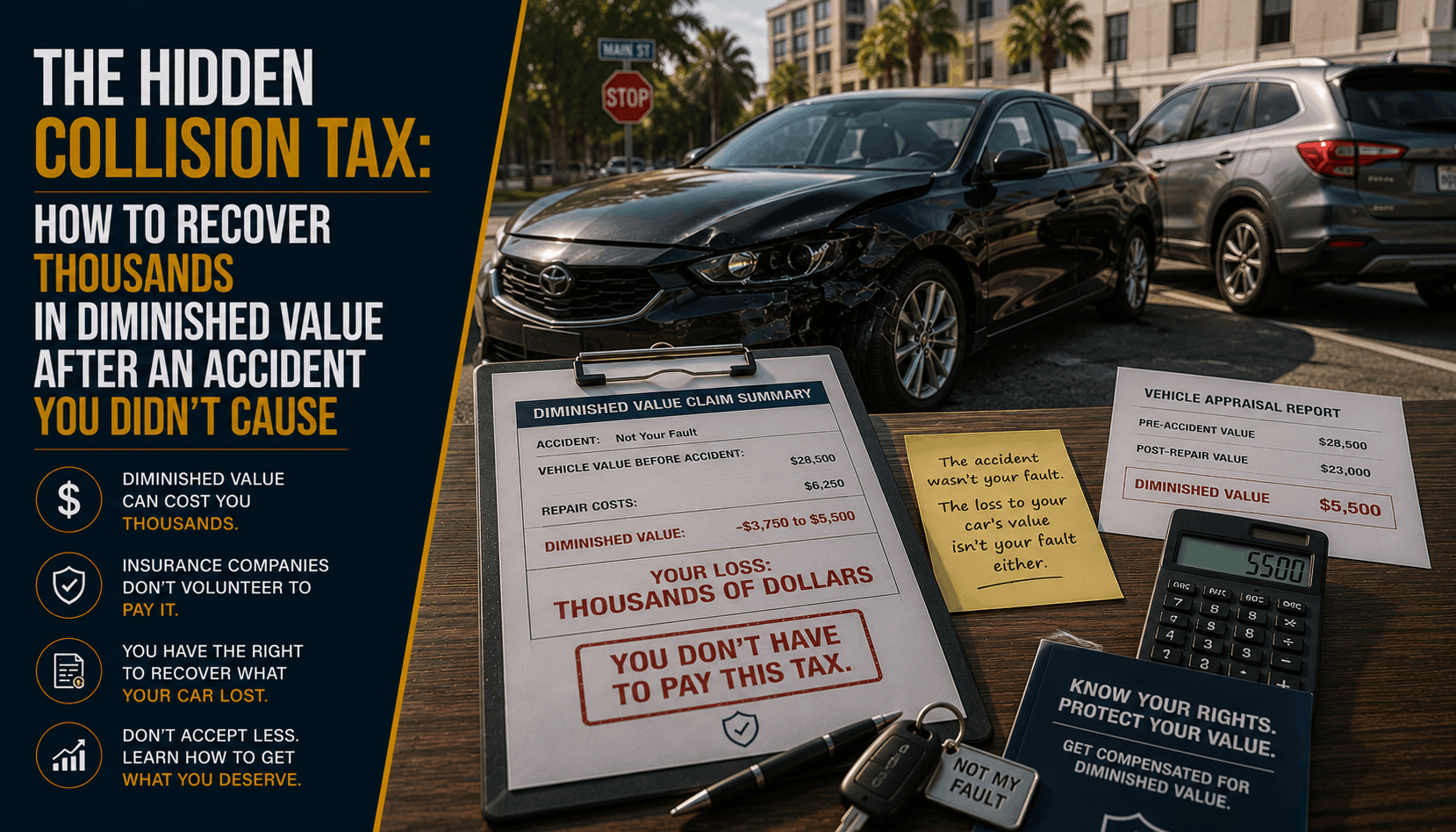
The short answer is yes—you can legally recover thousands of dollars in lost vehicle resale value after a crash you didn't cause by filing a Diminished Value Claim against the at-fault driver's insurance company. Even when a auto body shop restores your car to pristine physical condition, its vehicle history report (CARFAX or AutoCheck) will permanently reflect a structural accident record. Future buyers and dealerships routinely discount crash-history vehicles by 10% to 30% below market value. This loss of market worth is called Inherent Diminished Value. Because the other driver caused the property damage, their liability insurance is legally obligated under third-party tort law to make you whole—which means paying you for both the physical repair bills and the permanent loss in market value before you sell or trade in the car.
Accepting a repaired car back from the body shop without pursuing a diminished value claim leaves thousands of your hard-earned dollars on the table. Understanding how diminished value works—and how to calculate your loss—is essential to protecting your personal wealth.
1. The Three Types of Diminished Value
To build a bulletproof claim against the at-fault driver's insurance carrier, you must understand how appraisers classify post-accident value loss:
- Inherent Diminished Value: The most common form of claim. It represents the immediate drop in market value resulting solely from the vehicle having a recorded accident history, assuming high-quality, professional repairs were completed.
- Repair-Related Diminished Value: Additional value loss caused by substandard repair work, such as mismatched paint, improper frame alignment, or non-OEM part fitment.
- Immediate Diminished Value: The difference in vehicle value immediately after the collision but before any repairs are attempted (rarely used in insurance claims).
2. How Insurance Companies Calculate Diminished Value (The 17c Formula)
Insurance adjusters frequently use a standardized calculation known as the 17c Formula to minimize diminished value payouts. While consumer advocates often challenge this formula for underestimating loss, understanding its structure gives you leverage during negotiations:
Diminished Value=(Base Market Value×10%)×Damage Modifier×Mileage Modifier
- Base Loss Cap: The insurer caps maximum potential diminished value at 10% of the vehicle's pre-accident market value.
- Damage Modifier: Adjusters multiply the base loss by a decimal scale (ranging from 0.00 for minor panel damage to 1.00 for severe structural/frame damage).
- Mileage Modifier: A secondary decimal multiplier reduces the payout based on vehicle odometer readings (e.g., 1.00 for 0–19,999 miles down to 0.00 for 100,000+ miles).
Expert Tip: Insurance adjusters routinely use the 17c formula to offer low settlements. Obtaining an independent appraisal from a certified auto appraiser provides concrete local market evidence to demand a fair payout.
3. Step-by-Step Checklist to Claim Your Diminished Value Settlement
If you were involved in a crash caused by another driver, follow this actionable plan to collect your settlement:
- Step 1: Complete All Physical Repairs First. Ensure the at-fault driver's property damage liability policy covers 100% of the body shop repair invoice.
- Step 2: Obtain an Independent Diminished Value Appraisal. Hire a licensed vehicle appraiser to conduct a physical inspection or detailed market analysis documenting the post-repair market drop.
- Step 3: Submit a Formal Demand Letter. Send a written claim to the at-fault driver's insurance adjuster, attaching your independent appraisal, repair receipts, clean pre-accident photos, and market comparison reports.
- Step 4: Negotiate and Secure Settlement. Reject initial lowball offers. Remind the adjuster that third-party tort liability laws require full indemnification for all property losses caused by their insured.
Why Working with an Independent Agency Is Vital
Navigating complex property claims, liability limits, and coverage endorsements requires expert advisory. At Walker Insurance Agency, we help you structure your personal auto insurance portfolio so you are fully protected against uninsured drivers, hit-and-run incidents, and property loss disputes.
Insurance Agencies+ 1
The Walker Advantage:
- Comprehensive Coverage Reviews: We analyze your policy limits, collision coverage, and uninsured motorist protections to ensure no hidden financial gaps exist.
- Claims Guidance & Advocacy: If an accident occurs, our local team provides professional guidance to help you navigate claims and deal effectively with third-party adjusters.
- Tailored Protection Strategies: We evaluate your vehicle portfolio, loan terms, and daily usage patterns to deliver optimized coverage at competitive rates.
FAQ
1. Can I file a diminished value claim with my own insurance company?
Generally, no. First-party diminished value claims against your own policy are excluded in almost all states unless specifically mandated by law (such as in Georgia) or caused by an uninsured motorist under specific UM endorsements. Diminished value claims are typically third-party claims filed against the at-fault driver's insurer.
2. How long after an accident can I file a diminished value claim?
The timeline depends on your state's statute of limitations for property damage claims, which typically ranges from 2 to 4 years from the date of the accident. However, filing immediately after repairs are completed yields the strongest negotiation results.
3. What types of vehicles qualify for a diminished value claim?
Vehicles that yield the highest diminished value recoveries are typically less than 5 to 7 years old, have under 80,000 miles, carry a clean pre-accident history, and suffered moderate to severe structural or body damage exceeding $2,000 in repairs.
Don't Leave Your Car's Resale Value Behind
Repairing physical dented metal is only half the battle after a crash you didn't cause. Failing to pursue a third-party diminished value claim means taking a massive financial hit when it comes time to sell or trade in your car.
Take control of your auto insurance strategy today. Contact Walker Insurance Agency for a comprehensive policy audit. We provide the technical expertise you need to close coverage gaps, navigate complex property claims, and protect your personal financial security.
[GET A FREE QUOTE TODAY]
Call our personal lines division at +1-407-977-7100 or visit our office in Stuart, FL. Let us safeguard your property boundaries today.
Related Articles

¿Cubre el Seguro Hundimientos de Tierra o Grietas en Florida? (2026)
¿Aparecieron grietas en tus paredes o cimientos tras las lluvias en Florida? Descubre la diferencia entre Sinkholes y Catastrophic Ground Collapse en 2026.
Read More →
Found Cracks After Heavy Florida Rains? Sinkhole Coverage Rider 2026
Found cracks in your walls or foundation after Florida storms? Learn why standard home insurance denies sinkhole claims and why you need a sinkhole rider.
Read More →
¿Cubre el Seguro los Códigos de Construcción en Florida en 2026?
¿Vas a reconstruir tu casa tras un huracán en Florida? Descubre por qué los códigos de construcción pueden costarte $50,000 y cómo la cobertura Ordinance or Law te salva.
Read More →