The Attractive Nuisance Trap: Pool Injury Claims & Home Insurance (2026)
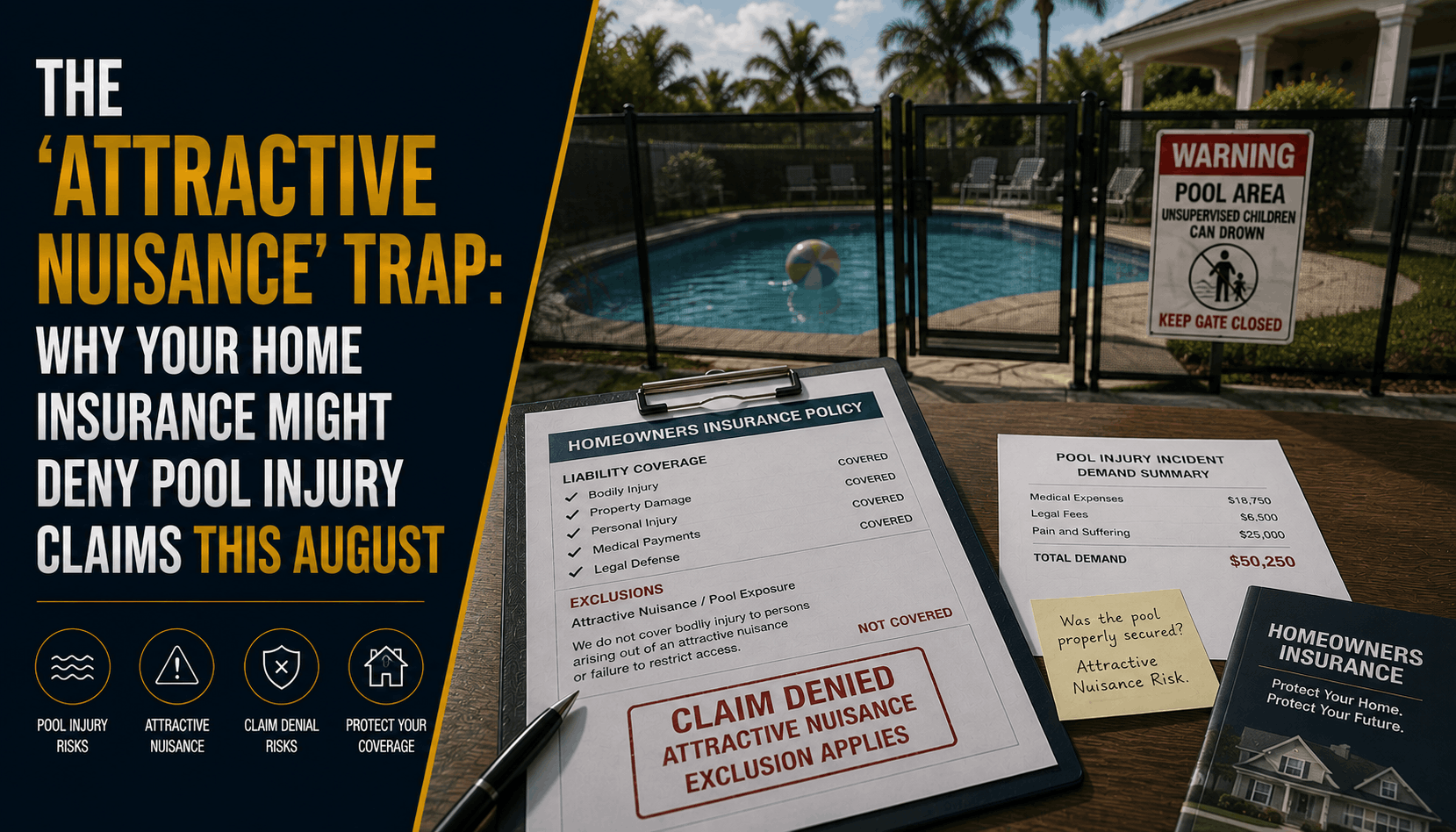
The 'Attractive Nuisance' Trap: Why Your Home Insurance Might Deny Pool Injury Claims This August
The Direct Answer
Here is the uncomfortable legal reality facing pool owners during peak summer: if a child enters your yard uninvited, falls into your swimming pool, and gets hurt, the law holds you financially responsible—and your home insurance company can outright deny the claim if you violated basic pool safety requirements.
Under a longstanding legal principle known as the Attractive Nuisance Doctrine, homeowners owe a special "duty of care" to protect neighborhood children from artificial hazards on their property. Because young kids lack the maturity to understand drowning risks, a swimming pool acts like a magnet.
If a neighbor's child wanders through an unlatched gate, climbs a flimsy fence, or slips onto an uncovered deck, you are legally liable. Even worse: if your insurer discovers you failed to maintain required safety barriers, omitted the pool from your original application, or installed an unapproved diving board, they can deny your personal liability claim completely. That leaves you defending a catastrophic personal injury lawsuit out of your own pocket.
August heatwaves mean neighborhood pool parties are in full swing—and uninvited swimmers are far more likely to wander into your yard. Finding out a child got hurt on your property is horrifying enough. Discovering your home insurance policy turned its back on you because of a broken latch makes a tragedy ten times worse.
1. Trespassing Doesn't Shield You: The Legal Mechanics
Most homeowners assume that if someone breaks into their yard without permission, they can't be sued. With adults, that is usually true. With children and swimming pools, the rules flip entirely:
- Children Don't Appreciate Danger: Courts recognize that young children are naturally curious and cannot fully comprehend drowning risks. The law expects you to anticipate that neighborhood kids might wander onto your property.
- A "No Trespassing" Sign Is Not Enough: Warning signs don't fulfill your legal duty. You are required to maintain physical barriers—like 4-foot enclosures with self-closing, self-latching gates.
- The Burden of Proof Is Low: If a claimant proves you knew local children lived nearby, knew your pool presented an unreasonable risk, and failed to secure it, you are liable for medical costs, emotional distress, and long-term care.
2. Why Insurance Carriers Deny Pool Injury Claims
Carriers don't automatically pay out just because you have liability coverage. When a severe injury occurs, insurance adjusters launch a detailed investigation. They commonly deny claims for three reasons:
- Failure to Disclose the Pool: If you installed an in-ground or above-ground pool (or even a deep temporary splash pool) and didn't notify your insurance agent, the carrier can void your liability coverage due to material misrepresentation.
- Non-Compliance with Safety Endorsements: Many policies contain explicit pool safety riders. If your policy requires a 4-foot fence with a working self-latching gate, and an adjuster finds a broken gate latch, the carrier can deny coverage based on a breach of policy terms.
- Excluded Diving Boards and Slides: Diving boards and multi-story pool slides cause a disproportionate number of spinal injuries. Most modern insurance companies strictly exclude these features or require specialized endorsements.
The Cost of a Slip-Up: The average medical cost for a non-fatal drowning or near-drowning incident can exceed $100,000 in immediate emergency care alone—not counting long-term therapy or civil lawsuit settlements. If your policy rejects the claim, those bills attach directly to your home equity, bank accounts, and future wages.
3. How to Protect Your Household Before the Summer Ends
Securing your backyard isn't just about avoiding a lawsuit; it's about keeping neighborhood kids safe. Take these three mandatory steps to protect your family and preserve your insurance coverage:
- Audit Your Perimeter Safety: Ensure your pool is enclosed by a fence at least 4 feet tall with self-closing and self-latching gates. Test the latch today—if it sticks or fails to catch automatically, repair it immediately.
- Increase Your Personal Liability Limits: A standard $100,000 liability limit is nowhere near enough if a severe pool injury occurs on your property. Bump your home policy liability to at least $300,000 to $500,000.
- Add a Personal Umbrella Policy: An umbrella policy provides an extra $1,000,000 to $2,000,000 in liability protection that kicks in once your primary home insurance limits are exhausted. It is the single cheapest way to secure total peace of mind for pool owners.
Why Working with an Independent Agency Matters
You shouldn't have to guess whether your pool setup satisfies your insurer's strict safety guidelines. At Walker Insurance Agency, we help local homeowners review their backyard exposures and eliminate dangerous coverage gaps.
- Proactive Property Reviews: We check your policy terms, point out missing pool endorsements, and ensure your safety setup meets carrier standards.
- Affordable Umbrella Options: As an independent agency, we compare top insurance carriers to find robust umbrella coverage at the best possible rates.
- Local, Friendly Service: Based right here in Stuart, Florida, we understand local pool safety laws and the real risks facing Florida families every summer.
FAQ
1. Does my standard home insurance cover pool injuries automatically?
It depends. While basic personal liability coverage can cover pool injuries, it is strictly subject to policy limits, safety conditions, and disclosures. If you haven't disclosed the pool or fail to maintain local code-compliant fencing, your claim can be denied.
2. Is an above-ground pool considered an attractive nuisance?
Yes. Even though above-ground pools have high walls, courts still view them as attractive nuisances because ladders and surrounding decks allow easy access for young children. You must secure or lock up the access ladder when the pool is not in use.
3. How much does a $1,000,000 personal umbrella policy cost for a pool owner?
It is surprisingly cheap. Adding a $1 Million Personal Umbrella policy typically costs between $150 and $300 a year just a few dollars a month for a massive safety net above your primary homeowners coverage.
Enjoy Your Pool Without Staking Your Financial Future
Hosting backyard swims should be the highlight of your summer, not a source of constant legal anxiety. Taking ten minutes to audit your gate latches and review your insurance limits gives you total confidence every time someone jumps in.
Protect your home and family today. Contact Walker Insurance Agency for a quick, zero-pressure policy checkup. We'll help you lock down the right liability protection so you can enjoy the rest of your summer worry-free.
[GET A FREE QUOTE TODAY]
Give our personal lines team a call at +1-407-977-7100 or visit our office at 789 SW Federal Hwy, Ste 201, Stuart, FL 34994. Let us safeguard what matters most to you.
Related Articles
Seguro Airbnb y Vrbo en Florida (2026): Cobertura de Huéspedes
¿Alquilas tu casa en Florida por Airbnb o Vrbo? Descubre por qué el seguro tradicional deniega reclamos por lesiones y daños en 2026 y cómo protegerte.
Read More →
Florida Airbnb & Vrbo Insurance (2026): Guest Injury & Claims
Renting your Florida home on Airbnb or Vrbo? Discover why standard homeowners policies deny guest injury and property claims, and how to stay protected in 2026.
Read More →
Seguro de Casa Histórica en Florida (2026): Cobertura Artesanal
¿Tienes una casa histórica en Florida? Descubre por qué el seguro estándar no paga materiales de época ni mano de obra artesanal en 2026 y cómo protegerla.
Read More →