Why Full Coverage Auto Insurance Won't Pay Your Car Loan (2026)
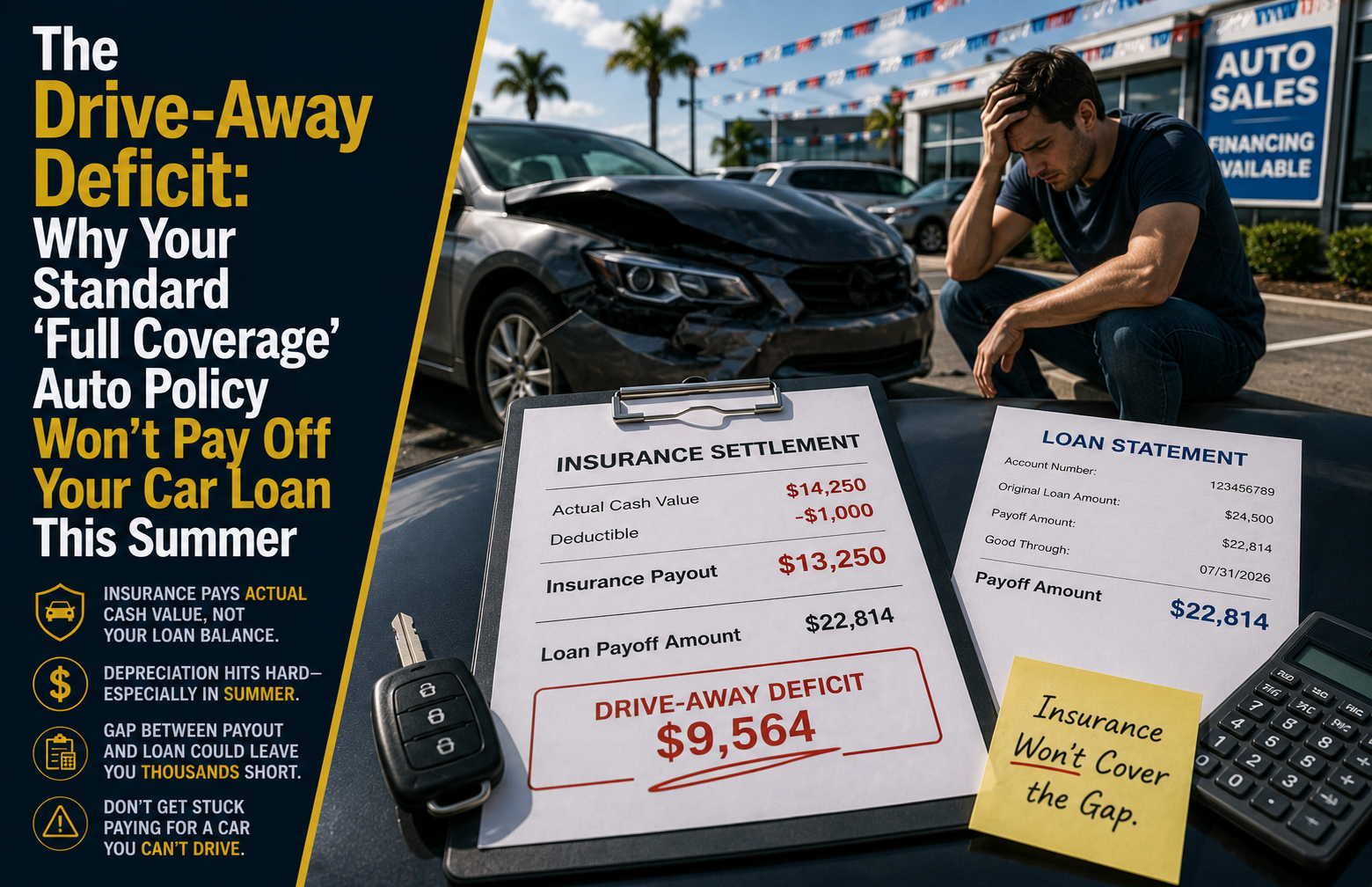
The Drive-Away Deficit: Why Your Standard 'Full Coverage' Auto Policy Won't Pay Off Your Car Loan This Summer
The Direct Answer
The short answer is no, it will not. In 2026, thousands of drivers across Florida hit the road under the dangerous assumption that having "full coverage" auto insurance means their car loan is completely wiped clean if their vehicle is totaled or stolen. This is a massive financial misconception. A standard full coverage policy—which consists of comprehensive and collision coverages—does not design its payouts around what you owe the bank. Instead, it explicitly promises to pay only the Actual Cash Value (ACV) of the vehicle at the exact second of the crash, minus your deductible. Because new cars depreciate rapidly the moment they leave the lot, your loan balance can easily outpace the car's depreciated market value. If your vehicle is declared a total loss this summer, your insurance company will send a check for its current market value, leaving you legally responsible for paying off the remaining thousands of dollars on the loan out of your own pocket.
For drivers across Stuart and the Treasure Coast, this financial disconnect—often called the "drive-away deficit" or negative equity—is hitting hard in 2026. With average new car prices remaining highly elevated and long-term financing options stretching out to 72 or 84 months, the shortfall between vehicle worth and loan liabilities has expanded to unprecedented levels, making standard policies a major vulnerability for unprepared buyers.
1. The Anatomy of the Deficit: Why Full Coverage Falls Short
The term "full coverage" is an industry misnomer that frequently creates a false sense of security. To understand why your baseline policy leaves a gap, you have to look at how auto financing and vehicle depreciation move in completely opposite directions:
- The Depreciation Sprint: A new vehicle routinely loses roughly 10% of its market value the minute the tires hit the pavement outside the dealership, and up to 20% within the first year. High-tech components, advanced driver assistance systems (ADAS), and complex EV powertrains accelerate this initial depreciation curve.
- The Amortization Crawl: When you take out an auto loan with a low down payment, your early monthly payments are structurally weighted toward interest charges rather than the principal loan balance. Your loan balance decreases at a slow crawl, while the car’s actual cash value drops like a stone.
- The Total Loss Threshold: In 2026, rising labor costs and expensive replacement parts mean insurance adjusters are declaring vehicles a "total loss" at a record pace—even after moderate accidents. When that happens, your insurer runs local market comparisons to determine the ACV. If your car is determined to be worth $28,000, but your bank statement shows you still owe $34,000, your personal insurance company closes the file after paying the $28,000. The remaining $6,000 deficit belongs entirely to you.
2. Real-World Risk Factors That Widen the Financial Gap
The drive-away deficit doesn't impact every driver equally, but certain structural buying habits create a perfect storm for a severe out-of-pocket bill after an unexpected summer collision:
- Low or Zero Down Payments: Putting down less than 20% upfront means your initial loan amount is almost identical to (or greater than) the purchase price of the car. You enter the contract with zero equity buffer, maximizing your vulnerability during the first 24 to 36 months of ownership.
- Rolling Over Negative Equity: One of the fastest ways to build a massive deficit is rolling an unpaid loan balance from a previous trade-in directly into a new car purchase. This inflates your new loan far beyond the physical value of the asset, leaving you severely "upside-down" from day one.
- Extended Financing Terms: Choosing a 60, 72, or 84-month loan to lower your monthly payment extends the period your loan balance remains higher than the car's real-world value. It prolongs your exposure to the drive-away deficit by multiple years.
3. How to Protect Your Savings and Eliminate the Loophole
You do not have to watch your personal savings evaporate after an unexpected total loss, but you must take proactive steps to bridge the contract gap before an accident occurs. At Walker Insurance Agency, we advise Stuart drivers to insulate their auto portfolios using a clear, tactical approach:
- Step 1: Calculate Your Current Equity Position. Contact your auto lender to get your exact payoff balance, then run a market valuation check on your vehicle using reliable local guides. Subtract the market value from your payoff amount to see exactly how large your personal drive-away deficit is right now.
- Step 2: Add a Guaranteed Asset Protection (GAP) Rider. If you find yourself holding negative equity, request your independent agent to bind a specialized GAP insurance rider directly to your personal auto policy. This targeted coverage explicitly steps in during a total loss to pay the shortfall between the actual cash value payout and your outstanding loan balance.
- Step 3: Compare Insurer Rates vs. Dealership Marks. Avoid rolling flat-fee GAP products into your primary auto loan at the dealership's F&I office, as you will end up paying interest on that protection for years. Sourcing a monthly GAP endorsement through an independent insurance agency is typically 50% to 70% cheaper and can be removed the moment your loan balance drops below the car's market value.
Why Working with an Independent Agency is Vital
Managing complex asset depreciation risks through generic digital forms makes it easy to miss the exact coverage boundaries that protect your personal capital. At Walker Insurance Agency, we provide the localized, data-driven protection you need to ensure an accident doesn't turn into a permanent debt cycle.
The Walker Advantage:
- Loan-to-Value Dissection: We thoroughly evaluate your auto financing structures alongside local Florida depreciation data to pinpoint your exact financial vulnerability windows.
- Wholesale Market Matching: We shop your profile across our expansive network of independent carriers to secure affordable GAP add-ons without forcing you into bloated, unnecessary line items.
- Local Market Scaling: We align your policy boundaries with actual Treasure Coast vehicle valuations so your family's hard-earned wealth remains completely insulated.
FAQ
1. Does a GAP insurance rider cover my personal insurance deductible?
It depends entirely on the specific carrier contract. Some premium GAP riders written in Florida include a deductible waiver that will cover up to $1,000 of your comprehensive or collision deductible, while basic policies expect you to cover your deductible before the gap payout triggers. We can review your policy details to confirm your exact layout.
2. Can I cancel GAP insurance once my car is worth more than what I owe on the loan?
Yes, absolutely. Unlike dealership-packaged financing additions that are permanently locked into the loan principle, an auto insurance GAP endorsement can be deleted from your policy the moment your regular payments bring you into a positive equity position, immediately lowering your monthly premium costs.
3. Does a standard policy pay off late fees or deferred payments carried on my car loan?
No. GAP insurance and standard policies only cover the core structural deficit created by standard vehicle depreciation. Any financial penalties, accumulated late fees, or deferred payments carried over from skipped payment cycles on your bank ledger will not be compensated under any auto claim.
Secure Your Financial Future Before the Unexpected Hits
A beautiful new car is a major personal investment, but assuming a vague "full coverage" label will protect your personal bank account from a major lending shortfall is a massive gamble. True financial security requires looking closely at your underlying loan terms and ensuring your written policy matches the physical reality of vehicle depreciation.
Take total control of your auto protection today. Contact Walker Insurance Agency for a comprehensive portfolio evaluation. We provide the strategic visibility you need to erase the drive-away deficit, deploy high-limit gap riders, and keep your hard-earned assets safe in Stuart.
[GET A FREE QUOTE TODAY]
Call our personal lines division at +1-407-977-7100 or visit our office in Stuart, FL. Let us safeguard your financial boundaries today.
To see a practical breakdown of how these financing traps operate firsthand and learn how to identify if your current loan structure places you at risk, check out this helpful Kia of St. Catharines GAP Insurance Guide which highlights the major red flags that make adding extra asset protection a vital financial decision.
Related Articles

Seguro Comercial en Florida: Paneles Solares y Pérdida de Energía (2026)
¿Instalaste paneles solares en tu edificio en Florida? Descubre por qué el seguro comercial estándar deniega la carga en techo, ráfagas y pérdida de energía en 2026.
Read More →
Florida Commercial Solar Insurance: Roof Load & Panel Claims
Installed commercial solar in Florida? Learn why standard property insurance denies roof load, wind uplift, and panel claims, and how to stay protected.
Read More →
Horse Boarding Insurance in Florida: Boarder Injury & Horse Loss
Boarding horses or giving riding lessons in Florida? Learn why standard farm insurance may not cover boarder injuries, horse losses, or equine liability.
Read More →