Car Seat After a Crash: Safety & Insurance
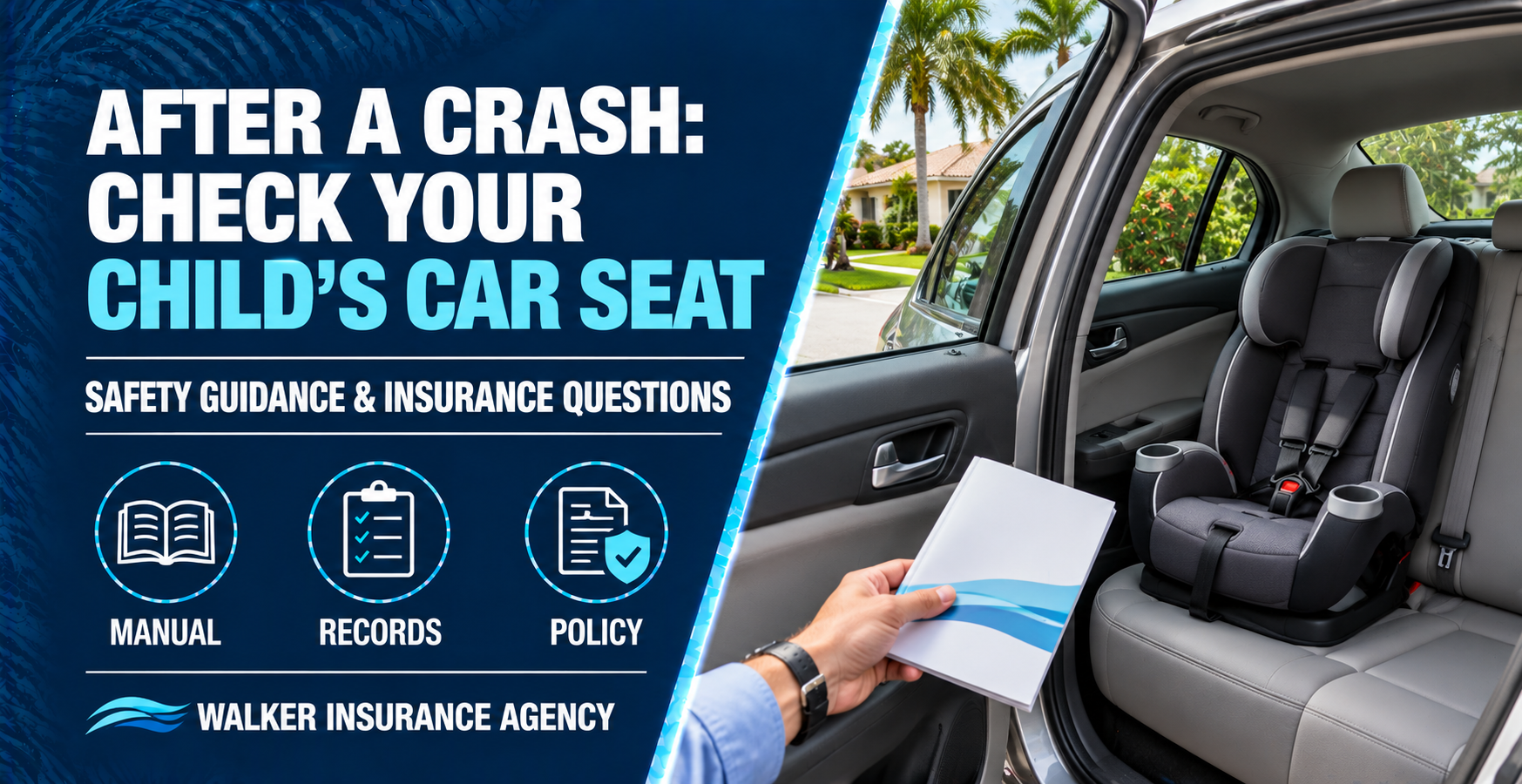
Child Car Seat After a Crash? Safety and Insurance Checks for Florida Parents
The Direct Answer
Check the seat manufacturer’s instructions before using a child restraint after a crash, and ask the insurer separately about replacement coverage. NHTSA recommends replacement after a moderate or severe crash; a minor crash does not automatically require it under NHTSA’s guidance. Manufacturer instructions still apply. A seat’s appearance, an insurer’s payment decision, and the decision about safe reuse are different questions.
For a parent in Stuart, vehicle repairs may quickly become the focus after an accident. Add the child restraint and any base involved to your list of immediate questions. Identify the product, obtain its instructions, and tell the claims representative that it was in the vehicle. Do not wait for visible cracks before asking what the manufacturer requires.
This guide helps organize the review. It does not inspect or clear a seat for reuse, promise reimbursement, or describe a Florida requirement that every insurer must replace every seat. The scenarios are illustrations, not customer claims.
1. Follow Safety Guidance Before Deciding About Reuse
NHTSA defines a minor crash using five conditions that must all apply: the vehicle could be driven from the scene; the nearest door was undamaged; no occupant was injured; airbags did not deploy; and the seat has no visible damage. Its guidance also says not to use a seat involved in a moderate or severe crash and to follow the manufacturer’s instructions.
Do not treat one favorable fact as the entire assessment. Being able to drive away does not answer the other questions. If details are uncertain, explain that uncertainty to the manufacturer instead of checking a box by assumption. Keep the product model and manufacture information available when asking for guidance.
Manufacturer rules can be more conservative. Chicco, for example, instructs replacement of its seat and base after a vehicle crash even without visible damage. That is a manufacturer example, not a rule to transfer to every brand. Obtain the instructions for your exact model and contact its manufacturer if the next step is unclear.
Illustrative scenario: Elena’s vehicle remains drivable, but she does not know whether the incident meets every relevant condition. She gathers the facts and contacts the seat maker with the model information. An informal description such as “just a small bump” does not resolve the question.
Keep the safety decision distinct from the reimbursement discussion. If the instructions require replacement, do not continue using the seat while waiting to learn whether insurance will pay. Explain the immediate transportation need to the manufacturer or an appropriate child passenger safety resource rather than improvising a repair.
2. Tell the Claims Team About the Seat and Ask What to Document
When reporting the accident, identify the child restraint and any separate base that were involved. Ask the claims representative to explain whether the policy addresses replacement, which coverage would apply, and what deductible or other conditions matter. Get the explanation tied to your issued contract and claim circumstances.
Progressive’s published guidance says collision coverage will typically replace a seat involved in an accident and that providers may pay even without obvious damage. This illustrates a possible coverage route, not a guarantee for every Walker client. Your insurer must explain the policy and any replacement process for your claim.
Prepare a concise file: product photographs, model and label information, available purchase records, manufacturer instructions, and the claim number. Ask what the insurer actually requires, including whether a replacement receipt, manufacturer statement, or other record is needed. Do not invent missing information or assume a particular document guarantees acceptance.
Illustrative scenario: Marcus no longer has the original receipt. He tells the representative what records remain and asks what alternative documentation may be considered. He also identifies the seat accurately, rather than replacing the missing price with a guess. The insurer’s response determines the next documentation step.
Before disposing of the old restraint, ask what evidence the insurer needs and how the manufacturer recommends retiring it. Preserving records does not mean continuing to use it or passing it to another family. Keep the safety instructions and the evidence request together so both can be handled deliberately.
Record the date, representative, requested documents, and next action after each conversation. If you receive conflicting explanations, request clarification from the claims team. A general article or an agency conversation cannot substitute for the insurer’s assessment of the reported loss.
3. Confirm the Replacement Process and Arrange the Next Safe Trip
Ask how a replacement purchase would be handled before assuming the insurer will buy any seat you choose. Clarify the eligible type or comparable replacement, any reimbursement instructions, and whether you must submit additional paperwork. Keep the proposed purchase and the claims answer separate until the process is clear.
Illustrative scenario: Priya needs a replacement promptly, but the claims team has not finished its review. She asks how to document a necessary purchase and what the insurer can confirm now. She does not interpret a pending claim as approval for an unlimited purchase or as permission to reuse a restraint that must be replaced.
For selecting and using the next seat, consult the product instructions and the vehicle manual. NHTSA’s Car Seat Finder and inspection resources can help locate appropriate information and certified child passenger safety assistance. An insurance representative can discuss coverage; that is not the same service as installation guidance.
Retain the replacement product details, available receipts, and the manufacturer’s response with the claim file. If you have more than one seat or base, list each item that was involved and ask about each one. Avoid assuming that an answer about a single restraint covers every product your household owns.
Why an Independent Agency Conversation Helps
Walker’s auto insurance service page explains that the agency works with multiple carriers and helps customers compare coverage choices. Bring the actual policy and the seat-related questions to that discussion. Ask which contact should handle the claim, where to find your selected coverages, and what needs clarification from the insurer.
Before a future accident, you can also ask how different auto proposals address this kind of expense. Compare the wording and deductible, not just a broad label such as “full coverage.” Neither an agency review nor a quote request certifies a seat’s condition or guarantees a payment.
Frequently Asked Questions
1. What if no child was sitting in the seat during the crash?
Tell the manufacturer that the restraint or base was present but unoccupied. Do not assume that absence of a child settles the reuse question. Chicco’s guidance specifically addresses unoccupied products; follow the instructions for your own model. Give the insurer the same accurate description when discussing the claim.
2. Does a seat that looks undamaged automatically qualify for reuse?
No. Appearance is not the entire assessment. Consult the relevant crash guidance and model instructions, and ask the manufacturer about uncertain facts. Do not treat a photograph, a repair shop’s opinion, or an insurance claim status as a product-specific clearance.
3. Will the insurer always pay for a new seat?
Payment must be confirmed for the policy and loss. Ask about applicable coverage, deductible, documentation, and replacement instructions. Keep the insurance decision separate from the manufacturer’s safety directions. A need to replace a product does not, by itself, establish the amount or availability of reimbursement.
Prepare the Questions Before the Next Trip
Identify the seat, obtain the safety instructions, and keep a clear claim record. Contact Walker Insurance Agency at 407-977-7100 or use Walker’s contact page for help reviewing your auto coverage questions. Request a quote through Walker’s quote page. The listed office is 789 SW Federal Highway, Suite 201, Stuart, FL 34994. A quote does not bind or change coverage.
Sources
NHTSA — Car Seat Use After a Crash: https://www.nhtsa.gov/car-seats-and-booster-seats/car-seat-use-after-crash
Chicco — Frequent Questions From New Parents: https://www.chiccousa.com/frequent-questions-from-new-parents/car-seat-safety-new-parents.html
Chicco — Car Seat Replacement After a Crash: https://www.chiccousa.com/baby-talk/do-i-need-to-replace-my-car-seat-after-a-crash/
Progressive — Does Insurance Cover Car Seats?: https://www.progressive.com/answers/does-insurance-cover-car-seats/
NHTSA — Car Seat Finder and Inspection Resources: https://www.nhtsa.gov/campaign/right-seat
Walker — Auto Insurance: https://www.walkerinsuranceagency.com/services/auto-insurance
Walker — Contact and Quote: https://www.walkerinsuranceagency.com/contact | https://www.walkerinsuranceagency.com/quote
Related Articles
Silla Infantil Después de un Choque: Seguro
Después de un choque, consulta las instrucciones de la silla infantil, reúne documentos y pregunta al seguro por el reemplazo. Guía para familias de Florida.
Read More →
Auto de Alquiler: Revisa la Cobertura Antes de Firmar
¿Vas a alquilar un auto? Revisa tu póliza, beneficios de tarjeta, exención de daños y contrato antes de recogerlo. Consulta tus dudas con Walker Insurance Agency.
Read More →
Rental Car Coverage: What to Check Before Signing
Renting a car? Review your auto policy, card benefits, damage waiver and rental agreement before pickup. Bring your questions to Walker Insurance Agency.
Read More →