Car Value Dropped 20% After an Accident? How to Recover Diminished Value
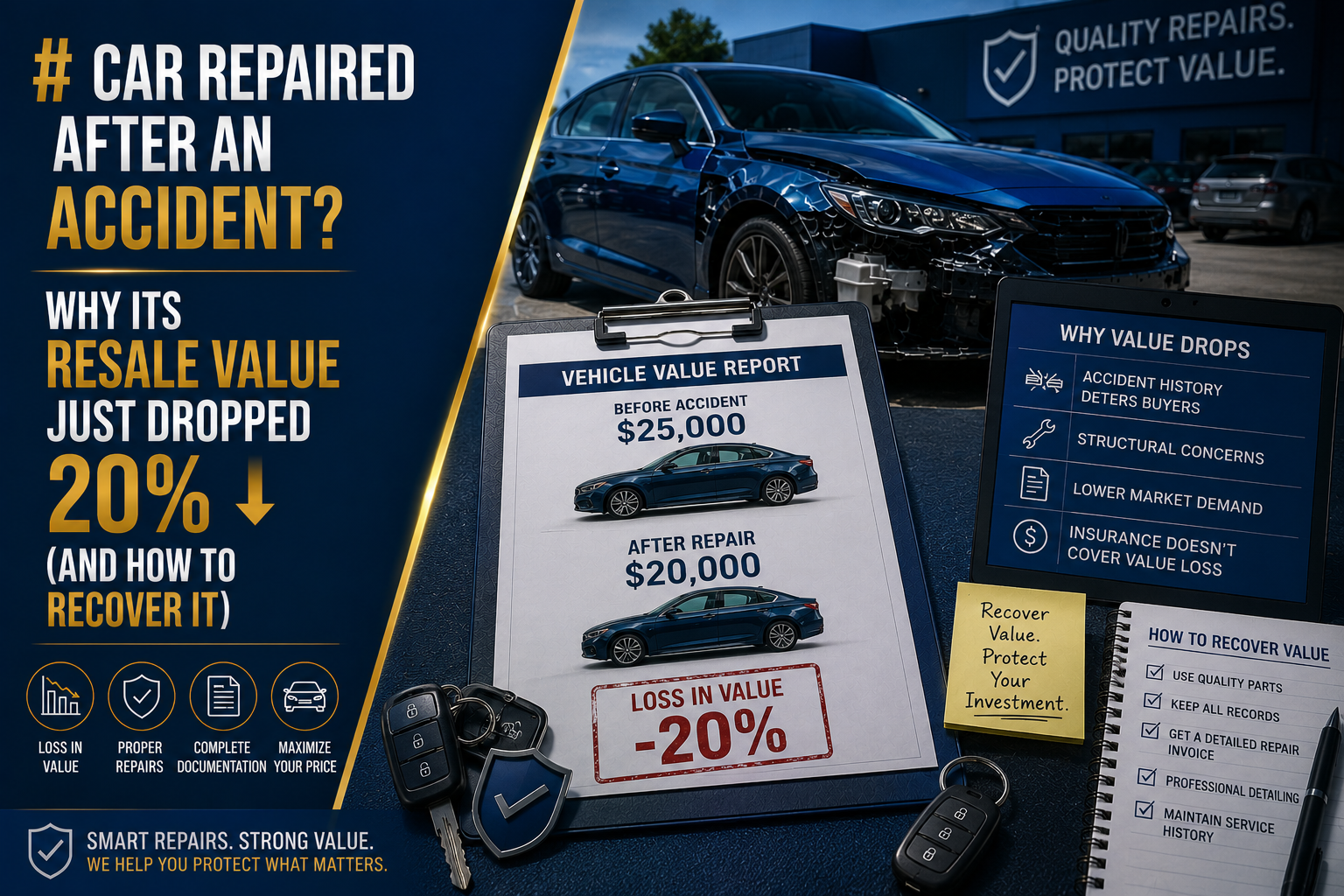
Car Repaired After an Accident? Why Its Resale Value Just Dropped 20% (And How to Recover It)
The Direct Answer
Here is a hidden financial blow that hits vehicle owners long after their car leaves the body shop: even if your car was repaired to perfection with 100% factory parts, its resale and trade-in value instantly drops by 15% to 30% the moment an accident appears on its Carfax or AutoCheck vehicle history report.
This sudden loss in market worth is known as Diminished Value.
When you go to sell or trade in a vehicle with a prior accident record, buyers and dealerships will automatically offer significantly less than they would for an identical car with a clean record. The good news? If you were not at fault in the collision, you have the legal right to file a Diminished Value claim against the at-fault driver’s insurance company to recover that lost equity in cash.
Getting your vehicle back from the repair shop after a crash feels like the end of a stressful ordeal. Discovering months or years later at a dealership trade-in desk that your car is worth thousands of dollars less solely because of that accident turns a past event into an ongoing financial loss.
1. What Is Diminished Value and Why Does It Happen?
Diminished Value is the economic loss in a vehicle's market value caused by an accident history. Even if a certified technician frame-aligns your vehicle and restores the paint flawlessy, buyers perceive a previously wrecked car as inherently riskier.
Insurance adjusters and automotive appraisers break diminished value down into three distinct types:
- Inherent Diminished Value (Most Common): The loss in market value that occurs simply because a vehicle now has an accident recorded on its history report. Even with flawless repairs, the market inherently values a clean-title car higher than a repaired one.
- Repair-Related Diminished Value: Value lost due to sub-par repair work, such as misaligned body panels, mismatched paint, or cheap non-OEM aftermarket parts used by the body shop.
- Immediate Diminished Value: The difference in the vehicle's market value immediately before the crash compared to its value immediately after the crash, prior to any repairs being performed.
2. The CARFAX Effect: How Accident History Destroys Equity
In 2026, virtually every dealership, buyer, and vehicle trade-in platform automatically pulls a vehicle history report before making an offer.
Here is how an accident record erodes your vehicle's financial value:
- 1. Dealership Trade-In Haircuts: Dealerships routinely apply an automatic 15% to 20% penalty on trade-ins with reported accident histories—even minor structural or cosmetic ones—because they cannot sell them as "Certified Pre-Owned" (CPO) vehicles.
- 2. Private Buyer Hesitation: Private buyers compare similar listings online. If two identical cars are priced at $25,000, but one has a reported collision, buyers will either demand a $3,000 to $5,000 discount or walk away entirely.
- 3. Structural and Safety Stigmas: Vehicles that suffered frame damage, airbag deployment, or suspension repairs face severe market skepticism regarding long-term alignment, tire wear, and crash safety.
Example of Financial Loss: If your vehicle was worth $30,000 before a non-fault accident and suffered $6,000 in repairable damage, its post-repair resale value might drop to $23,000. That $7,000 gap is your Diminished Value loss—money out of your pocket when you sell.
3. Step-by-Step: How to Recover Your Lost Car Value
If you were involved in an accident where another driver was at fault, you do not have to absorb this loss silently. You can file a Third-Party Diminished Value Claim:
- Do Not Sign a Full Liability Release Early: Ensure you do not sign a final release or waiver with the at-fault driver's insurance company until you have evaluated your diminished value rights.
- Obtain an Independent Diminished Value Appraisal: Hire a certified professional auto appraiser to generate a detailed, market-backed valuation report establishing your vehicle's exact pre-crash vs. post-repair value.
- Submit a Formal Demand Letter: Send the appraisal report and a formal demand letter to the at-fault driver's insurance adjuster requesting compensation for the diminished value amount.
- Negotiate Your Settlement: Insurance adjusters will initially try to dismiss or underpay diminished value claims using generic formulas. Presenting your independent appraisal provides the concrete evidence needed to secure a fair payout.
Why Working with an Independent Agency Matters
Understanding your rights after an auto accident requires knowledgeable insurance guidance. At Walker Insurance Agency, we don't just write policies—we help our policyholders navigate complex post-accident scenarios and protect their overall vehicle investments.
- Post-Accident Guidance: We advise policyholders on how to properly document accident damage, review repair shop estimates, and identify diminished value opportunities.
- Comprehensive Coverage Review: We audit your auto policy to ensure you have proper collision, comprehensive, and uninsured motorist coverage to protect your car's equity before accidents happen.
- Local, Dedicated Advocacy: Located in Stuart, Florida, our independent agency delivers honest, personalized support to keep your family, your vehicles, and your savings protected.
Frequently Asked Questions
1. Can I file a Diminished Value claim if the accident was my fault?
Generally, no. In most states, standard auto insurance policies explicitly exclude first-party diminished value claims. You can typically only recover diminished value from the other driver's insurance company when they are at fault.
2. Is there a time limit for filing a Diminished Value claim?
Yes. Diminished value claims fall under your state's statute of limitations for property damage. In Florida, for example, property damage claims generally have a specific window, so it is best to initiate your claim as soon as repairs are completed.
3. How much does a Diminished Value appraisal cost?
A professional, independent diminished value appraisal typically costs between $200 and $500 depending on the vehicle's complexity and market value. This upfront cost is often recovered easily given that diminished value payouts routinely range from $2,000 to over $8,000.
Recover Your Vehicle’s Equity and Protect Your Savings Today
Don't let someone else's driving mistake strip thousands of dollars in resale value from your car or truck. Understanding your rights to a Diminished Value claim ensures you collect the full financial recovery you are legally owed after an accident.
Keep your vehicle, family, and financial future completely secure. Contact Walker Insurance Agency today for a fast, zero-pressure auto insurance review. We're here to help you protect every dollar tied to your vehicle.
[GET A FREE AUTO INSURANCE AUDIT TODAY]
Give our auto insurance team a call at +1-407-977-7100 or visit our office at 789 SW Federal Hwy, Ste 201, Stuart, FL 34994. We are always here to keep your vehicle, your equity, and your savings safe.
Related Articles

Seguro de Casa en Florida: Cobertura de Jaula de Alberca (2026)
¿Se destruyó tu jaula de alberca (pool cage) o mosquitero tras un huracán en Florida? Descubre por qué el seguro básico no lo cubre y cómo solucionarlo en 2026.
Read More →
Florida Hurricane Pool Cage Damage: Screen Enclosure Claims
Collapsed pool cage or damaged patio screen after a Florida hurricane? Learn why standard home insurance denies screen enclosure claims and how to buy coverage.
Read More →
Ley de Coincidencia de Techos en Florida (2026): Tejas No Coincidentes
¿Daños en el techo tras un huracán en Florida? Descubre cómo la Ley de Coincidencia obliga a la aseguradora a cambiar todo el techo si las tejas no coinciden.
Read More →