Why Auto Insurance Forces Cheap Aftermarket Parts (2026)
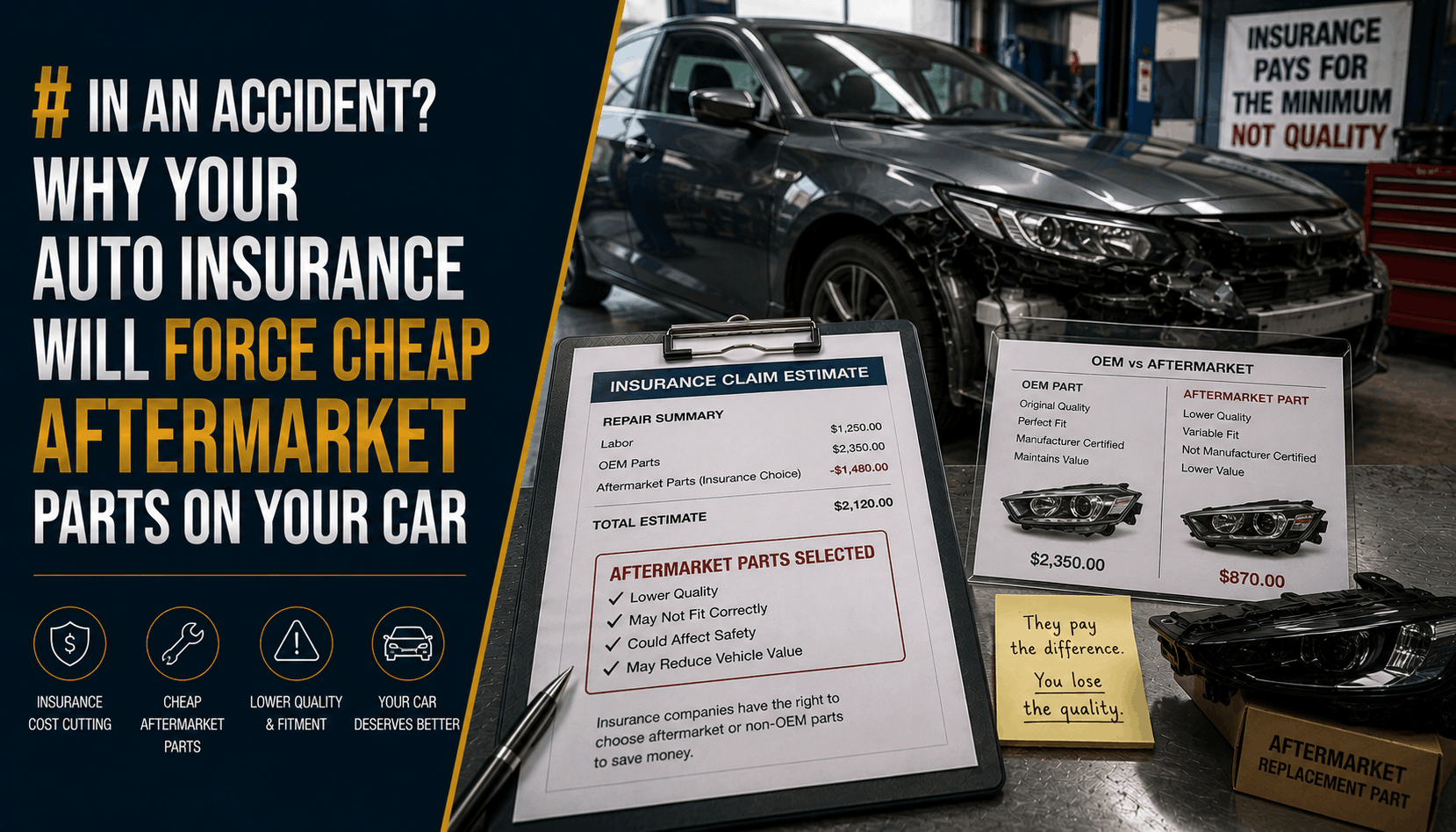
In an Accident? Why Your Auto Insurance Will Force Cheap Aftermarket Parts on Your Car
The Direct Answer
Here is the unsettling reality facing vehicle owners after a collision in 2026: unless your auto insurance policy contains a specific OEM (Original Equipment Manufacturer) endorsement, your insurance carrier will legally force the body shop to use cheap, non-OEM aftermarket parts to repair your car.
Standard auto insurance policies require the carrier to restore your vehicle to "like kind and quality" at the lowest possible cost.
Insurance companies meet this requirement by authorizing imitation, non-OEM replacement parts—including pattern bumpers, generic fenders, and knock-off headlight assemblies—manufactured by third-party suppliers. These parts are significantly cheaper for the insurer, but they frequently fit poorly, compromise safety crumple zones, and severely erode your car’s resale value.
Getting into a vehicle collision is stressful enough on its own. Discovering during the repair process that your insurance company is paying for cheap, non-factory replacement parts—rather than genuine components built by your vehicle's manufacturer—turns a minor accident into a major blow to your vehicle's quality and safety.
1. OEM vs. Aftermarket Parts: What Is the Real Difference?
When your car enters a collision repair facility, the body shop generates an estimate listing every replacement part required. Insurance adjusters immediately audit this estimate to replace factory components with lower-cost alternatives:
- Original Equipment Manufacturer (OEM) Parts: Parts made directly by your vehicle's manufacturer (e.g., Ford, Toyota, BMW) specifically for your exact make and model. They match original factory standards for metal thickness, crash-test safety, fit, alignment, and corrosion resistance.
- Aftermarket (Non-OEM) Parts: Imitation parts manufactured by third-party companies. While they mimic the appearance of original components, they vary wildly in quality, metal gauge, paint bonding, and structural integrity.
- Salvage / Used Parts: Components pulled from wrecked vehicles in salvage yards. Insurers frequently authorize used suspension arms, doors, and tailgates to avoid paying for brand-new factory parts.
2. Why Insurance Companies Prefer Aftermarket Components
Carriers rely on policy language to keep repair costs as low as possible. Understanding why they push non-OEM parts helps you spot the risks before authorizing repairs:
- 1. Massive Cost Savings for the Carrier: Aftermarket body panels and light assemblies often cost 30% to 60% less than genuine OEM components. Across tens of thousands of claims, this saves insurance companies millions of dollars each year at your vehicle's expense.
- 2. The "Like Kind and Quality" Policy Loophole: Standard personal auto contracts promise to restore your car to operational condition, but they rarely guarantee new factory parts. Insurers interpret "like kind and quality" to mean any part that physically fits the vehicle frame.
- 3. Misaligned Sensors & Advanced Safety Systems (ADAS): Modern vehicles rely on bumper-mounted radar, cameras, and sensors for automatic emergency braking and lane-keeping assistance. Cheap aftermarket bumpers and grilles often lack precise sensor mounts, causing safety system miscalibrations.
Safety & Resale Value Impact: Non-OEM metal panels may crumple differently during a second crash, compromising passenger cabin protection. Additionally, trade-in appraisers can easily spot misaligned aftermarket panels and generic headlight housings, significantly lowering your car's market trade-in value.
3. How to Demand Genuine OEM Parts for Your Vehicle
You do not have to settle for cheap imitation parts after an accident. You can protect your vehicle's structural integrity and resale value through three key steps:
- Add an OEM Parts Endorsement: Upgrade your auto policy with an OEM Parts Rider. This optional endorsement legally obligates your insurer to pay for brand-new, genuine factory parts on all covered collision and comprehensive repairs.
- Review the Repair Estimate Before Signing: Always inspect the body shop estimate. Look for terms like LKQ (Like Kind and Quality), AM (Aftermarket), or A/M. If you see these designations, the adjuster is specifying non-factory components.
- Pay the Price Difference (Out-of-Pocket Option): If you lack an OEM endorsement, you can ask the body shop to order original factory parts and pay the price difference between the aftermarket part and the genuine OEM component yourself.
Why Working with an Independent Agency Matters
Navigating repair estimates, policy riders, and carrier repair guidelines requires practical insurance advocacy. At Walker Insurance Agency, we help vehicle owners audit their auto coverage to ensure their cars are repaired with genuine factory components after a crash.
- Custom Auto Policy Audits: We review your current declarations page, explain your carrier's stance on aftermarket parts, and add OEM endorsements to guarantee factory repairs.
- Access to Top-Rated Insurers: As an independent brokerage, we partner with premier insurance companies that offer affordable OEM parts endorsements and higher repair standards.
- Local, Dedicated Guidance: Located in Stuart, Florida, our team provides clear, straightforward advice to protect your family's safety, vehicle value, and personal savings on the road.
Frequently Asked Questions
1. Is it legal for insurance companies to use aftermarket parts?
Yes. In most states, insurance companies are legally allowed to specify aftermarket or recycled parts for collision repairs, provided the parts meet general safety standards and are noted on the written repair estimate.
2. Will using aftermarket parts void my car's manufacturer warranty?
Using aftermarket collision parts will not void your entire vehicle warranty, but the car manufacturer will not cover defects, rust, or failures caused by non-OEM parts or improper installation by a body shop.
3. Does an OEM Parts Endorsement cover lease vehicles?
Yes! In fact, an OEM parts endorsement is strongly recommended for leased vehicles. Auto leasing companies often penalize drivers at lease return if non-genuine aftermarket parts were used to repair accident damage during the lease term.
Protect Your Vehicle's Safety, Parts, and Resale Value Today
Don't wait for a highway collision to discover that your auto insurer plans to rebuild your car with cheap aftermarket knock-offs. Taking a few minutes to audit your policy and add an OEM Parts Endorsement ensures your vehicle is restored using genuine factory components every single time.
Keep your car, family, and financial investment completely secure. Contact Walker Insurance Agency today for a fast, zero-pressure auto policy review. We'll help you secure the right coverage so you can drive with complete peace of mind.
[GET A FREE OEM AUTO QUOTE TODAY]
Call our dedicated auto insurance team at +1-407-977-7100 or visit our office at 789 SW Federal Hwy, Ste 201, Stuart, FL 34994. We're always here to keep your vehicle, your passengers, and your savings safe.
Related Articles

Seguro de Casa en Florida: Cobertura de Jaula de Alberca (2026)
¿Se destruyó tu jaula de alberca (pool cage) o mosquitero tras un huracán en Florida? Descubre por qué el seguro básico no lo cubre y cómo solucionarlo en 2026.
Read More →
Florida Hurricane Pool Cage Damage: Screen Enclosure Claims
Collapsed pool cage or damaged patio screen after a Florida hurricane? Learn why standard home insurance denies screen enclosure claims and how to buy coverage.
Read More →
Ley de Coincidencia de Techos en Florida (2026): Tejas No Coincidentes
¿Daños en el techo tras un huracán en Florida? Descubre cómo la Ley de Coincidencia obliga a la aseguradora a cambiar todo el techo si las tejas no coinciden.
Read More →