Does Home Insurance Cover Legal Fees & Lost Wages from Identity Theft? (2026)
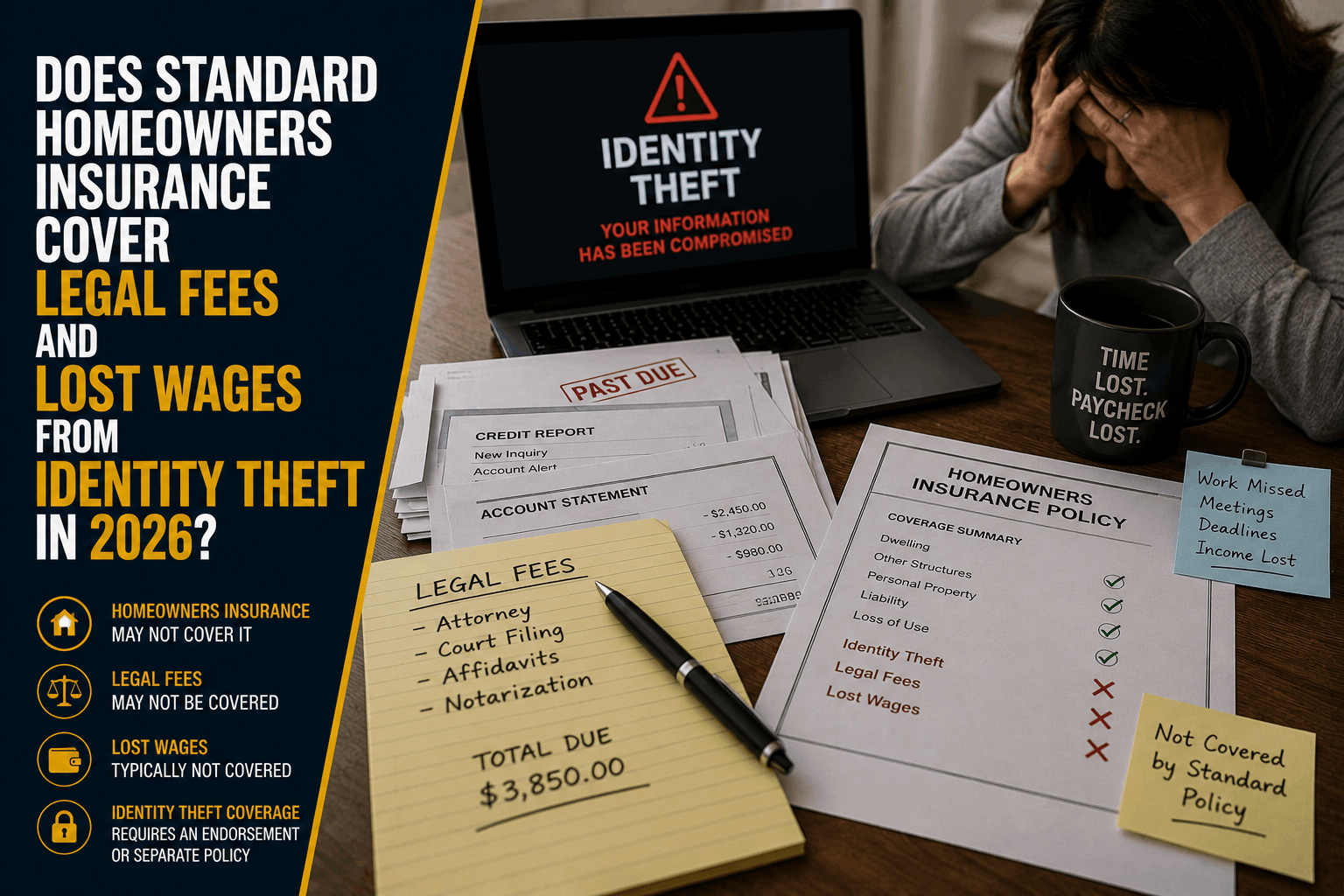
Does Standard Homeowners Insurance Cover Legal Fees and Lost Wages from Identity Theft in 2026?
The Direct Answer
The short answer is no, standard homeowners insurance (HO-3 or HO-6) does not cover legal fees or lost wages from identity theft. Baseline home insurance policies are designed to protect against direct physical damage to your dwelling and tangible personal property (like fire, windstorms, or burglary). Under standard contract terms, digital identity fraud, unauthorized credit account creation, and tax fraud do not cause physical loss to property. To get reimbursement for legal defense fees, missed work wages, court costs, and notarization fees spent recovering your name, you must purchase an optional Identity Theft Restoration Endorsement. When attached to your homeowners policy, this endorsement provides $10,000 to $25,000 in dedicated coverage specifically designed to reimburse out-of-pocket restoration expenses, including lost income and attorney fees incurred while clearing fraudulent debts.
When an identity thief opens fraudulent credit accounts, files fake tax returns, or commits medical identity fraud in your name, the financial fallout extends far beyond unauthorized credit charges. Victims often spend dozens of hours taking time off work, hiring specialized consumer attorneys, and navigating court hearings to remove fraudulent judgments. Knowing how homeowners insurance handles these indirect expenses—and how to close critical policy gaps—is essential for modern financial protection.
1. Why Standard Policies Exclude Fraud-Related Income Loss and Legal Bills
Standard homeowners policies strictly separate physical property losses from intangible administrative recovery costs:
- The Physical Loss Requirement: Homeowners policies require "direct physical loss or damage" to trigger primary coverage. Digital credentials, credit scores, and Social Security numbers are classified as financial assets rather than physical property.
- The Personal Property Limitation (Coverage C): Standard coverage for personal property protects items like furniture, clothing, and electronics. Cash, securities, and digital account balances are subject to tiny policy sub-limits (typically capped at $200 for cash and zero for digital credit profiles).
- Administrative Expenses Are Excluded: Basic policies pay to replace stolen physical items, but they do not cover the indirect costs of fixing administrative damage—such as taking unpaid administrative leave from your job to meet with investigators or hiring an attorney to dispute fraudulent debts.
2. What an Identity Theft Endorsement Actually Covers
Adding an Identity Theft Restoration Endorsement to your policy converts standard home insurance into a robust fraud recovery plan. These specialized riders reimburse specific out-of-pocket costs incurred during the restoration process:
Reimbursement for lost wages is typically covered when you must take documented, unpaid time off work to file police reports, attend court depositions, or meet with law enforcement agencies. Policies usually cap wage reimbursement with daily limits (e.g., $250 to $500 per day) up to an aggregate sub-limit (e.g., $2,500 to $5,000 total).
Legal fees are reimbursed when you must hire a licensed attorney to remove civil judgments, defend against fraudulent debt collection lawsuits, or resolve tax identity fraud with federal and state revenue agencies. In addition, endorsements reimburse certified mailing costs, loan re-application fees, notary public fees, and fees for credit monitoring services.
Crucial Reality: Identity theft insurance does not pay back money stolen directly from your checking account—banks and federal consumer protection laws (like the Fair Credit Billing Act) handle stolen funds. The endorsement exists to pay for the expensive legal work, lost income, and administrative fees required to clear your credit record and restore your reputation.
3. How to Ensure Full Legal and Wage Recovery
If you want complete coverage for identity theft recovery costs, take these three strategic steps:
- Step 1: Request an Identity Theft Endorsement. Contact your insurance provider and add an Identity Theft Restoration rider to your homeowners, condo, or renters policy. These endorsements typically cost between $25 and $60 per year for up to $25,000 in dedicated coverage.
- Step 2: Confirm Case Management Support. Select an endorsement that includes dedicated fraud case manager services. A professional resolution specialist handles paperwork and contacts credit bureaus on your behalf, reducing the amount of unpaid work time you must take.
- Step 3: Keep Strict Documentation. To collect wage and legal fee reimbursements, maintain meticulous records—including signed affidavits from your employer confirming unpaid missed work hours, detailed attorney billing logs, and certified mail receipts.
Why Working with an Independent Agency Is Vital
Selecting the right policy endorsements and navigating fine-print coverage limits requires professional expertise. At Walker Insurance Agency, we review personal insurance policies to ensure you have complete protection against both physical and digital losses.
The Walker Advantage:
- Targeted Policy Audits: We evaluate your current home insurance policy to identify hidden exclusions, sub-limits, and missing identity protection riders.
- Carrier Selection: As an independent agency, we partner with top national and regional insurance carriers to find comprehensive identity theft endorsements at competitive rates.
- Local Florida Expertise: Based in Stuart, FL, we understand the specific risks facing Florida homeowners and offer personalized claims advocacy when issues arise.
FAQ
1. How much lost wage coverage is provided under an identity theft endorsement?
Most identity theft endorsements provide between $1,500 and $5,000 in total lost wage reimbursement, often capped at $250 to $500 per day. The missed work time must be directly tied to identity restoration tasks, such as attending court hearings, filing police reports, or meeting with legal counsel.
2. Are legal fees covered if I hire an attorney for identity theft?
Yes, provided you have an active Identity Theft Endorsement and the attorney is hired to handle qualifying legal matters—such as removing fraudulent liens, defending against unauthorized debt collection suits, or resolving tax fraud. Policies typically require prior approval from the insurer or enforce hourly fee caps (e.g., $125 to $200 per hour).
3. Does identity theft coverage pay a deductible?
Many identity theft endorsements feature a zero-dollar deductible or a low $100 deductible. Because this coverage operates as a specialized rider rather than a standard property claim, accessing wage and legal reimbursements usually does not trigger your primary home insurance deductible.
Protect Your Income and Legal Security Today
Don't wait until a fraudulent credit account or tax scam disrupts your finances to find out if your policy covers recovery costs. Adding a dedicated identity theft endorsement gives you complete peace of mind and financial backing when you need it most.
Take control of your personal security today. Contact Walker Insurance Agency for a comprehensive coverage review. We provide the tailored advice you need to eliminate policy gaps, optimize endorsement limits, and keep your hard-earned income fully protected.
[GET A FREE QUOTE TODAY]
Call our personal lines division at +1-407-977-7100 or visit our office at 789 SW Federal Hwy, Ste 201, Stuart, FL 34994. Let us safeguard what matters most to you today.
Related Articles

Cobertura de Ley y Ordenanza en Florida (Ordinance or Law) 2026
¿Cubre el seguro de casa en Florida las actualizaciones obligatorias del código de construcción? Descubre cómo la Regla del 50% te afecta en 2026.
Read More →
The 50% Rule in Florida: Storm Damage & Building Codes 2026
Did a storm damage 40% or more of your Florida home? Learn how the 50% Rule can force total code upgrades and cost you over $150,000 out of pocket.
Read More →
¿Cuánto Tiempo Tengo para Reclamar Daños por Tormenta en Florida? (2026)
¿Tuviste daños por agua o tormenta en Florida? Conoce la regla estricta de 1 año para reportar tu reclamo al seguro en 2026 y evita que sea denegado.
Read More →