Florida Home Insurance Declarations Page: What to Check
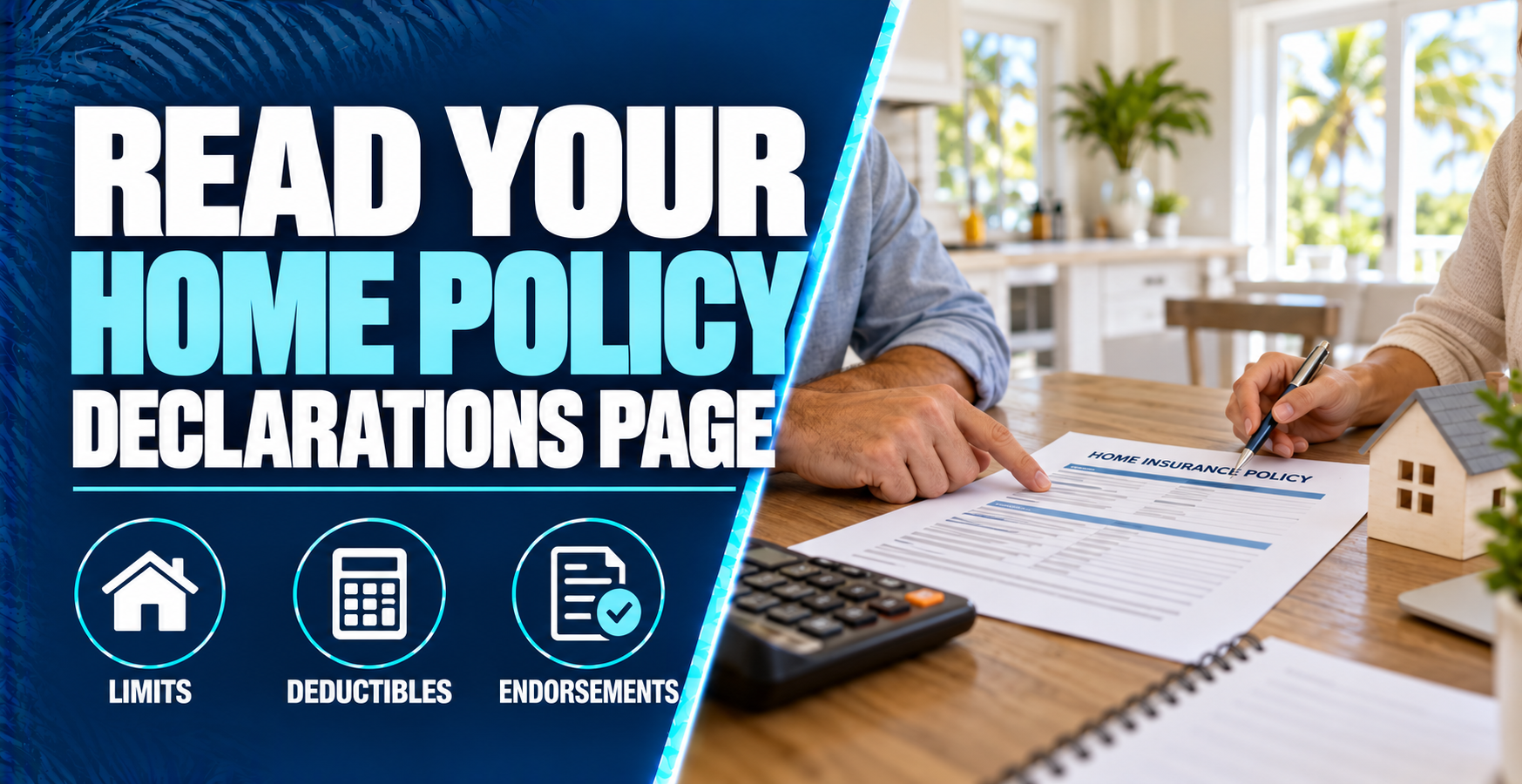
Primary Keyword: Florida home insurance declarations page
Search Intent: Understand a policy summary and compare renewal coverage before requesting a quote.
Cover PNG: https://drive.google.com/file/d/1iyAa40hdm_HsD228x7ZyEKi3Fw01nB24/view?usp=drivesdk
Before You Renew: How to Read Your Florida Home Insurance Declarations Page
The Direct Answer
Your homeowners insurance declarations page summarizes the policy issued for your property: who is insured, the policy period, the insured location, coverage limits, deductibles, premium and listed forms or endorsements. Use it to begin a review, not to decide every coverage question. Exclusions, definitions and endorsements elsewhere in the contract can change how the policy responds. A lower renewal premium is meaningful only after you compare the protection and the out-of-pocket amounts attached to it.
Picture two renewal options on your kitchen table. One costs less, and both display a familiar dwelling limit. It is tempting to choose the cheaper price immediately. But if one has a higher deductible or different restrictions, the proposals are not necessarily equivalent. Reading the summary in a consistent order helps you identify the questions to ask before making that decision.
1. Confirm What the Policy Actually Identifies
Start with the practical details before comparing prices. The NAIC identifies the declarations page as a summary of policy information, including insured property, effective dates, mortgage information and coverages. Use the current issued version and ask for missing pages rather than relying on an old renewal email.
Check the people, property and dates: Confirm the named insured and the property address, then locate the beginning and ending dates of the policy term. If you recently moved, changed ownership or changed mortgage companies, flag any inconsistent information for your agent. A billing document and a policy summary serve different purposes.
Separate the coverage categories: Dwelling, other structures, personal property and loss of use address different property exposures. Personal liability and medical payments to others are separate categories. Do not treat the largest limit printed on the page as one general fund for every kind of loss. Check which categories and limits your particular policy actually lists.
Find the forms and endorsements list: A name or form number on this list points you to policy wording you should also read. Florida's Insurance Consumer Advocate explains that endorsements add or adjust coverage, terms or conditions. Some can broaden protection; others can limit it. Ask for the actual form when a title is unclear.
2. Read the Numbers Before Comparing the Premium
A limit, a deductible and a premium answer different questions. Treating them as interchangeable can make a quote appear more protective than it is. The following examples are illustrations, not predictions about your policy or a claim payment.
The dwelling limit is not your home's sale price: Suppose you bought a home for $500,000. That transaction price does not by itself establish the cost to rebuild its structure. Florida's consumer guidance distinguishes replacement cost from market value, which includes land. Ask what rebuilding estimate supports the proposed dwelling limit rather than requesting a change simply to match the purchase price.
Convert a percentage deductible into dollars: If a hypothetical policy uses a hurricane deductible of 2% of a $400,000 Coverage A limit, the calculation is $8,000. That is not 2% of a $20,000 repair bill. Read the base stated in your own policy and ask when that deductible applies. Florida also distinguishes hurricane and other-peril deductibles; one number may not describe every loss.
Check the conditions behind a listed limit: Imagine that an optional coverage appears on both quotes, but the attached forms use different limits or separate deductibles. Matching coverage names would not settle that comparison. Read the endorsements and ask the agent to identify the difference in plain language before treating the two offers as equal.
There is another reason to avoid judging a policy by the summary alone: a listed limit is not a promise that every event involving that property will be paid. Coverage still depends on the cause of loss and the contract's exclusions, conditions and settlement terms.
3. Use a Simple Review Process Before Renewal
Turn the page into a short list of questions you can resolve. You do not need to interpret every policy form on your own; you do need to know which version you are comparing and what remains unanswered.
Step 1: Put the documents side by side. Gather the current declarations, the renewal or replacement proposal, and the applicable forms. Compare the same categories across each document. Mark changed limits, deductible amounts and form numbers. Keep the old and new versions labeled so you do not mix terms from different policy periods.
Step 2: Write the practical question for each change. Instead of asking whether the new policy is better, ask what a particular deductible means in dollars, what an endorsement changes, or whether the current rebuilding estimate reflects recent work on the home. Ask for the relevant policy wording when an answer depends on the contract.
Step 3: Confirm the issued terms and dates. If you request a correction or coverage change, verify the insurer's response and effective date in the updated documents. Do not assume that a discussion, quote request or note on your own copy changes the contract. Review the final paperwork before relying on a requested adjustment.
Why Working with an Independent Agency Matters
At Walker Insurance Agency, we help Florida residents explore home insurance options with access to multiple carriers. A useful comparison starts with your property and coverage questions. Bring the complete documents so the conversation can address more than the headline premium. You can explore our home insurance services at https://www.walkerinsuranceagency.com/.
Questions to Bring to Walker
Coverage comparison: Which limits and endorsements differ between my current policy and the proposal?
Out-of-pocket planning: What dollar amounts do the applicable deductibles represent, and what conditions determine which one applies?
Property changes: What information about a renovation, purchase or change in occupancy should I discuss before renewing?
FAQ
1. Is the declarations page the entire insurance policy?
No. It summarizes key information. Review the policy forms, exclusions, conditions and endorsements as well. Ask your agent or insurer for a complete copy if those documents are missing.
2. Does a lower premium mean I found the same coverage for less?
Not necessarily. Compare the limits, deductibles and attached forms first. A price difference alone does not establish that two policies provide equivalent protection.
3. What should I do if information on the page looks wrong?
Contact your agent or insurer, explain the discrepancy and request clarification or correction as appropriate. Keep the response and review any revised documents. Do not assume that an error automatically creates or removes coverage; that question depends on the facts and contract.
Understand the Policy Before You Choose the Price
Before your next renewal decision, set aside the premium for a moment. Check the insured details, compare the limits, calculate percentage deductibles and identify the forms you still need to read. Bring your unanswered questions to a conversation about your household's needs.
Contact Walker Insurance Agency to discuss available Florida home insurance options and your coverage questions.
[GET A FREE QUOTE TODAY]
Call +1-407-977-7100 or visit 789 SW Federal Highway, Suite 201, Stuart, FL 34994. Contact: https://www.walkerinsuranceagency.com/contact
Sources
NAIC — Understanding Your Homeowners or Renter's Policy: https://content.naic.org/article/consumer-insight-understanding-your-homeowners-or-renters-policy
Florida DFS — Hurricane Deductible: https://myfloridacfo.com/division/consumers/consumerprotections/floridashurricanedeductible
Florida Insurance Consumer Advocate — Policy Endorsements: https://myfloridacfo.com/division/ica/fullcoverage/homeowners/policyendorsements
Florida DFS — Homeowners Insurance FAQs: https://myfloridacfo.com/division/consumers/understanding-insurance/faq/home
Related Articles
Seguro de Inundación al Comprar Casa en Florida: Vigencia
¿Compras casa en Florida? Conoce cuándo puede aplicar la excepción del NFIP por préstamo y qué confirmar sobre pago, cierre y fecha de inicio del seguro.
Read More →
Flood Insurance at Closing in Florida: When Does It Start?
Buying a Florida home? Learn when an NFIP loan exception may apply and what to confirm about payment, closing and your flood policy’s effective date.
Read More →
Página de Declaraciones del Seguro de Casa en Florida
Aprende a leer la página de declaraciones de tu seguro de vivienda en Florida. Revisa límites, deducibles y endosos antes de comparar precios.
Read More →