Horse Boarding Insurance in Florida: Boarder Injury & Horse Loss
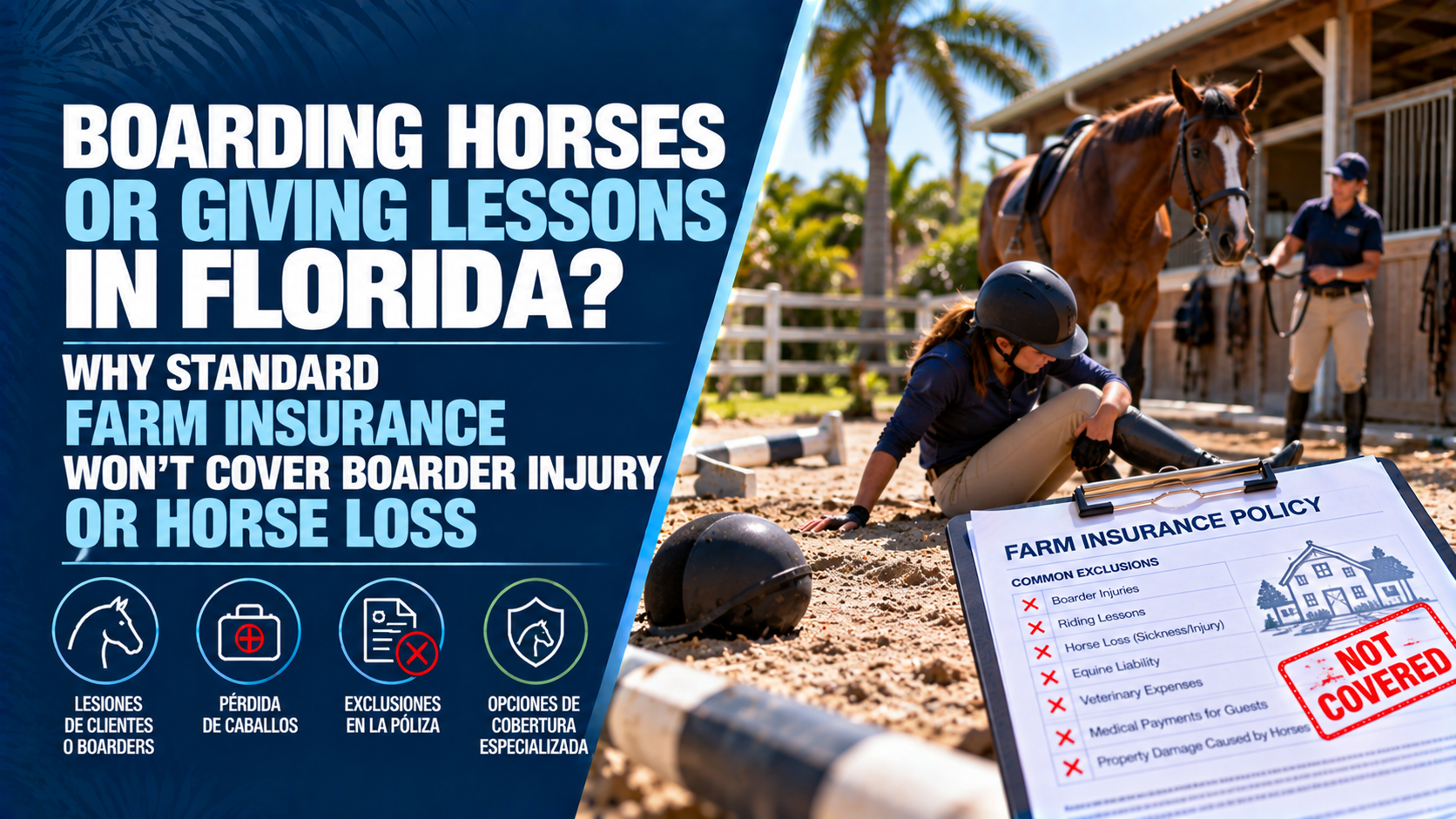
Boarding Horses or Giving Riding Lessons in Florida? Why Standard Farm Insurance May Not Cover Boarder Injury or Horse Loss
The Direct Answer
Standard farm insurance may not provide the liability and property coverage needed if you board horses, provide riding lessons, or allow customers to ride on your Florida property. These activities can create business exposures that are different from ordinary farm or personal horse ownership.
If a boarder's horse is injured, escapes, becomes ill, or dies while in your care, your standard farm policy may not automatically cover the loss. Likewise, if a student is injured while taking a riding lesson, your personal liability coverage may not be designed to respond to a commercial equine operation.
This is why Florida horse owners who board horses, offer riding lessons, train horses, host riding activities, or operate an equine business should review their insurance before accepting clients or boarders.
The right policy may need to address equine commercial liability, care/custody/control exposures, horse mortality, premises liability, and business property separately.
1. Why Standard Farm Insurance May Not Be Enough
Owning horses on a farm and operating a horse-related business are two different insurance risks.
A personal or farm policy may be designed primarily for your own agricultural activities and personal use. Once you begin charging customers for services, the risk profile changes.
Examples include:
- Boarding horses for other owners
- Providing riding lessons
- Training horses
- Horse breeding operations
- Leasing horses
- Trail rides or guided riding
- Horse shows or clinics
- Equine events
- Selling or transporting horses
- Offering horse-related recreational activities
The key issue is that a commercial activity can create liability exposures that are not automatically covered by a standard personal or farm policy.
2. What Happens If a Boarder's Horse Is Injured or Dies?
One of the biggest insurance concerns for a boarding operation is the horse belonging to someone else.
Imagine a customer leaves a $30,000 performance horse at your facility.
While the horse is being boarded, it:
- Becomes seriously ill
- Is injured in its stall
- Escapes from the property
- Is injured in a pasture
- Is involved in an accident
- Dies unexpectedly
The horse's owner may expect your business to be responsible for the loss.
However, liability for an animal in your care does not necessarily work the same way as coverage for your own property.
This is where specialized equine coverage becomes important.
Depending on the policy, care, custody, or control coverage may help address certain situations involving animals belonging to customers while they are under your responsibility.
Without appropriate coverage, a serious claim could become a significant out-of-pocket expense.
3. What If a Student Gets Injured During a Riding Lesson?
Riding lessons create another major exposure.
Even with experienced instructors and properly maintained horses, horseback riding involves inherent risks.
A student could:
- Fall from a horse
- Be kicked or stepped on
- Be injured while mounting or dismounting
- Be injured while handling a horse
- Become injured because of equipment failure
- Be injured on the riding arena or property
A standard homeowner or farm liability policy may not be designed to cover a business that charges customers for riding instruction.
That's why operators offering lessons should ask specifically about commercial equine liability coverage rather than assuming their existing policy provides sufficient protection.
4. Horse Boarding Creates Multiple Liability Exposures
Boarding isn't simply about providing a stall and feeding a horse.
Depending on the services offered, a boarding operation can create exposure related to:
Property Damage
A boarded horse could damage:
- Fencing
- Stalls
- Gates
- Equipment
- Vehicles
- Neighboring property
Bodily Injury
A customer, employee, visitor, student, or delivery driver could be injured on the property.
Animal Injury
A boarded horse could become injured or ill while under the facility's care.
Escape
A horse could escape through damaged fencing and enter a public road, creating the potential for a serious accident.
Employee or Contractor Activity
Employees or contractors handling horses can create additional liability exposures.
The insurance solution needs to reflect the actual services your operation provides, not simply the fact that horses are located on a farm.
5. Horse Mortality Coverage Is Different From Liability Coverage
Another important distinction is between liability insurance and horse mortality insurance.
They are not the same thing.
Liability coverage generally addresses claims against you when you may be legally responsible for injury or property damage.
Horse mortality coverage, depending on the policy, can insure the value of an individual horse against covered causes of death.
For example, a horse owner may have a $50,000 horse used for:
- Competition
- Breeding
- Training
- Racing
- Showing
- Recreation
If the horse dies, liability insurance does not automatically mean the owner receives the horse's insured value.
That's why high-value horses may require separate mortality or other specialized equine coverage.
6. What Insurance Should a Florida Horse Boarding Business Consider?
The appropriate insurance program depends on the operation, but a Florida equine business may need to evaluate several types of coverage.
1. Commercial Equine Liability
Designed to address liability exposures associated with horse-related business activities.
2. Care, Custody & Control Coverage
May address certain claims involving animals belonging to customers while they are in your care, subject to policy terms and exclusions.
3. Horse Mortality Coverage
Can protect the insured value of an eligible horse against covered causes of death.
4. General Liability
Can address certain third-party bodily injury and property damage claims arising from business operations.
5. Commercial Property
May protect buildings, equipment, tack, supplies, and other business property against covered losses.
6. Workers' Compensation
If you have employees, Florida requirements and the specific nature of your operation should be reviewed with an insurance professional.
7. Commercial Auto
If vehicles or trailers are used for business purposes, personal auto coverage may not be sufficient.
7. Florida's Equine Activity Liability Laws Do Not Replace Insurance
Florida has specific laws addressing liability associated with equine activities.
However, an equine liability statute should not be treated as a substitute for insurance.
Legal protections may have specific requirements, exceptions, and limitations.
For example, an equine professional may still face liability depending on the circumstances surrounding an accident.
That's why horse businesses should consider both:
Legal risk management + appropriate insurance coverage.
This can include:
- Proper contracts
- Participant agreements
- Waivers and releases
- Warning signs
- Safety procedures
- Facility maintenance
- Employee training
- Appropriate insurance
An insurance professional can help determine which protections are appropriate for your specific operation.
8. What Should You Tell Your Insurance Agent?
When requesting a quote, don't simply say:
"I have a horse farm."
Explain exactly what happens on the property.
Tell your agent if you:
- Board horses
- Charge boarding fees
- Give riding lessons
- Train horses
- Host clinics
- Offer trail rides
- Lease horses
- Breed horses
- Transport horses
- Host competitions
- Allow customers to ride
- Employ trainers or stable workers
- Care for high-value horses
The more accurately the insurer understands your operation, the better positioned you are to identify appropriate coverage.
9. How to Protect Your Florida Equine Business Before a Claim
Before accepting another boarder or student, consider taking these steps:
Document Every Horse
Maintain records showing ownership, identification, condition, value, and relevant medical information.
Use Written Boarding Agreements
Clearly define responsibilities for feeding, veterinary care, emergency treatment, turnout, transportation, and other services.
Review Your Liability Coverage
Confirm that your policy specifically addresses the commercial equine activities you perform.
Ask About Care, Custody & Control
If you care for horses belonging to customers, ask whether this exposure is covered and what exclusions or limits apply.
Review High-Value Horses
Owners of valuable horses should discuss mortality and other specialized coverage options.
Review Your Contracts and Waivers
Legal documents should be reviewed by an appropriate attorney and coordinated with your insurance strategy.
Why Work With an Independent Insurance Agency?
Equine businesses can have very different insurance needs depending on what they do.
At Walker Insurance Agency, we can help Florida horse owners and equine businesses review their current insurance program and identify potential coverage gaps.
We can help evaluate:
- Farm and ranch insurance
- Equine liability
- Horse boarding operations
- Riding instruction
- Care, custody, and control exposures
- Horse mortality coverage
- Property protection
- Commercial liability
- Business auto exposures
The goal isn't simply to find a policy with a low premium.
The goal is to make sure your insurance reflects how your business actually operates.
Frequently Asked Questions
Does farm insurance cover horse boarding in Florida?
Not necessarily. Boarding horses for compensation can create a commercial exposure that may require specific coverage or an endorsement. Review the exact policy language with your insurance professional before assuming boarding activities are covered.
Does homeowners insurance cover riding lessons?
Generally, you should not assume that a homeowners policy provides adequate coverage for a commercial riding-instruction operation. Business activities and equine-related liability may require specialized coverage.
What happens if a boarder's horse dies on my property?
Responsibility depends on the circumstances, contracts, applicable law, and insurance policy. Specialized care, custody, and control coverage may be important for businesses caring for horses owned by others.
Does equine liability insurance cover the horse itself?
Not necessarily. Liability coverage and horse mortality coverage serve different purposes. A horse's insured value may require separate specialized coverage.
Do I need insurance if I only board a few horses?
Potentially. The number of horses does not automatically determine whether a commercial exposure exists. If you charge for boarding or provide other paid equine services, discuss the operation with an insurance professional.
Are riding lessons considered a business activity?
Generally, if you charge customers for instruction, the activity is a business exposure and should be disclosed to your insurer.
Protect Your Florida Horse Business Before an Accident Happens
Your farm may be your home, your business, and the place where valuable horses are entrusted to your care.
Don't assume that a standard farm policy automatically covers every activity taking place on your property.
If you board horses, provide riding lessons, train horses, or operate another equine business in Florida, review your insurance before a claim exposes a coverage gap.
Contact Walker Insurance Agency for a review of your current coverage and discuss whether your policy properly addresses your equine business activities.
[REQUEST AN EQUINE INSURANCE REVIEW TODAY]
Call +1-407-977-7100 or visit Walker Insurance Agency at 789 SW Federal Hwy, Ste 201, Stuart, FL 34994.
Related Articles
¿Cubre el Seguro de Finca un Caballo Lesionado en Florida? | 2026
¿Un caballo de terceros se lesionó o un jinete cayó en tu propiedad de Florida? Descubre qué puede cubrir tu seguro de finca o casa en 2026.
Read More →
Seguro para Casas Históricas en Florida: Materiales y Mano de Obra (2026)
¿Tienes una casa antigua o histórica en Florida? Descubre por qué el seguro básico deniega la restauración artesanal y cómo proteger tu patrimonio en 2026.
Read More →
Historic Home Insurance Florida: Hand-Crafted Repairs & Materials
Own a historic home in Florida? Learn why standard insurance denies hand-crafted repairs, period materials, and code upgrades, and how to protect your property.
Read More →