RV Personal Belongings Coverage in Florida
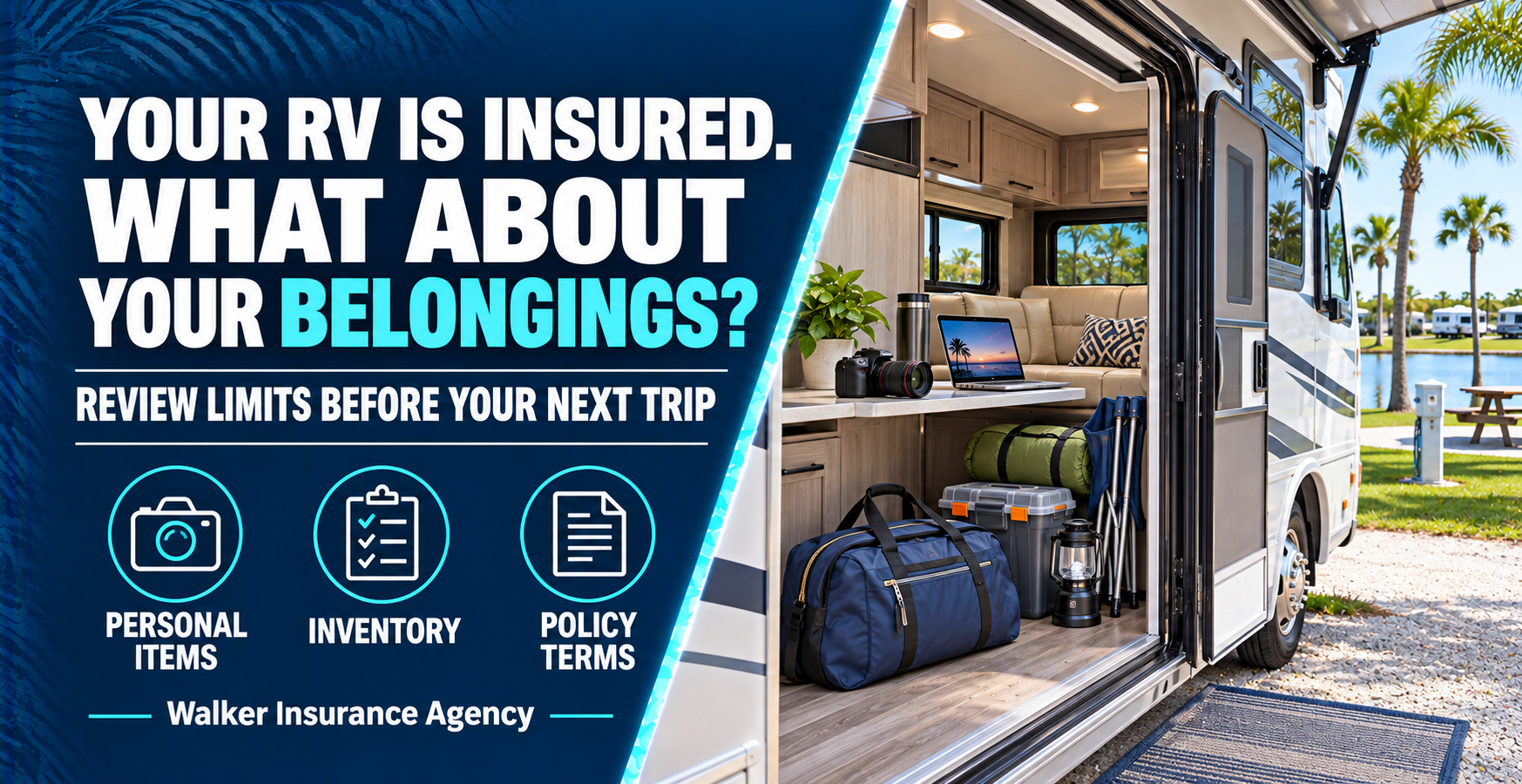
Your RV Is Insured. What About the Belongings Inside?
The Direct Answer
An insurance policy covering your RV does not, by itself, establish how every possession inside will be protected. Review whether personal effects coverage is selected, which items and losses it addresses, the applicable limits, and how a covered loss would be settled. Progressive describes RV personal property protection as an optional coverage with a chosen limit. Your own policy controls; a general description is not a coverage determination.
Before leaving Stuart for a camping trip, you may check fuel, tires, and reservations. Give the belongings you pack their own review: a camera, computer, clothing, cooking supplies, and outdoor gear can represent a different concern from damage to the RV itself. You do not need to predict a claim to prepare useful questions.
The three checks below help organize that conversation. Scenarios are illustrations, not customer claims or promises of payment. Confirm availability and terms for your particular Florida policy before relying on a coverage option.
1. Identify Which Coverage Applies to Each Item
Start with your declarations, endorsements, and coverage forms. Ask the agent to identify the wording addressing belongings and explain whether the protection is included, optional, or absent from your current selection. Keep the explanation with your policy documents rather than relying on the phrase “the RV is fully insured.”
Distinguish movable possessions from installed equipment when preparing your questions. Foremost’s RV shopping guide treats personal property and attached equipment as separate subjects to discuss. Ask where your policy places a portable camera, a mounted accessory, or equipment added after purchase. Do not classify an item solely by where you keep it.
Illustrative scenario: you load a portable television for a weekend away and also have a permanently installed entertainment system. Write both on your review list. Ask which policy section addresses each, what proof of installation or ownership might be useful, and whether an added accessory needs to be disclosed. Let the contract and insurer’s explanation resolve the distinction.
Also describe the trip accurately: where you plan to travel, whether the RV is stored between trips, and whether you use it occasionally or as your residence. Ask whether those facts affect the proposed protection. These are questions for your specific arrangement, not an assertion that every policy treats each use the same way.
If you have homeowners or renters insurance, bring that policy too. Foremost advises checking possible exceptions for property inside a motorized vehicle. Ask the relevant insurers how the contracts apply to the same item and loss; do not assume two policies mean two payments or complete protection.
2. Review Limits and Settlement Terms Before Choosing an Amount
Prepare a realistic packing list before discussing a limit. Group the items you actually take, and flag expensive or unusual belongings for individual questions. Ask about a total limit, any item or category restrictions, the deductible if applicable, and exclusions relevant to the items on your list. Request the policy wording supporting each answer.
Use the current cost of replacing an item as a discussion point, not as a promised claim amount. The NAIC explains that actual cash value considers depreciation, while replacement-cost coverage uses a different valuation basis. That general distinction does not establish which settlement method your RV contract uses.
Illustrative scenario: an older laptop still works well, but replacing it would cost more than its current used value. Ask which valuation applies, what conditions must be met, and what evidence the insurer would request. Also ask whether payment is handled in stages. Do not assume the original purchase price decides the settlement.
Some RV products offer replacement-cost protection for personal belongings; Progressive and Foremost describe such options on their product pages. Product descriptions illustrate why a comparison can be worthwhile. They do not prove that a specific option is included in your policy or available through every insurer in Florida.
Compare proposals using the same list of belongings and intended use. Record the selected protection, valuation language, deductible, and unanswered questions alongside the premium. If one proposal leaves a question unresolved, request clarification before treating the two offers as equivalent. Confirm the effective date of any accepted change before traveling.
3. Make an Inventory You Can Access Away From the RV
The NAIC recommends documenting belongings with identifying information, available receipts, and photographs. Adapt that recordkeeping approach to the items you carry in your RV. An inventory documents property; it does not add coverage, remove exclusions, or guarantee that a particular record will satisfy a claim requirement.
As a practical starting point, photograph each storage area and record the items you would find difficult to identify later. Add a model or serial number when available, ownership details, and an honest note where information is missing. Keep a usable copy outside the RV so that one incident does not remove both the belongings and their records.
Illustrative scenario: after returning from a trip, you replace a camera but keep the same bag and accessories. Update the record before the next departure. Ask whether the change warrants a coverage review instead of assuming an older inventory still reflects what you carry.
If a loss occurs, contact the insurer for reporting and documentation instructions. Ask what to preserve, whether a theft report is needed, and what steps to take before disposing of damaged property. Keep your notes and available records; the insurer evaluates the actual facts under the contract.
Why an Independent Agency Review Helps
A useful comparison looks beyond the premium to the property, use, and policy terms involved. Walker Insurance Agency’s auto service page states that it works with multiple carriers, and its services listing includes RV insurance. Ask which RV options are available for your situation rather than assuming every product described by a national insurer is offered through the agency.
Bring your RV information, current policies, intended travel and use, and your belongings list. Ask Walker to help identify the selected personal effects protection, explain questions about equipment and movable items, and seek clarification on limits and settlement terms. For background on the agency’s offerings, visit Walker’s insurance services page.
Frequently Asked Questions
1. Does comprehensive coverage on my RV automatically protect everything inside?
Do not infer that from the label alone. Locate the personal belongings wording and ask how the selected protection applies to your possessions. Damage to the unit and loss of an item inside raise different policy questions. Request an answer tied to the relevant forms and endorsements.
2. Can I rely on my homeowners policy for things in the RV?
Ask before relying on it. Bring both policies and describe the property, location, and intended RV use. Have the insurers explain applicable restrictions and how any overlapping protection would operate. The presence of belongings coverage on a home policy does not settle every RV-related situation.
3. Will keeping receipts guarantee replacement at today’s price?
No. Receipts help document a purchase; payment still depends on the covered event, policy limits, valuation terms, deductible, and other conditions. Ask which documents the insurer may need and how settlement works. Keep the inventory current, while treating it as evidence rather than a promise of reimbursement.
Review What You Pack Before Your Next Trip
A short policy review can turn a vague assumption about belongings into specific questions you can resolve before departure. Contact Walker Insurance Agency to discuss RV insurance and the possessions you carry. Call 407-977-7100 or use Walker’s contact page. The agency lists its office at 789 SW Federal Highway, Suite 201, Stuart, FL 34994.
Sources
Progressive — RV Personal Property Coverage: https://www.progressive.com/answers/rv-personal-property-coverage/
Foremost — Questions to Ask an RV Insurance Agent: https://www.foremost.com/learning-center/top-motor-hometravel-trailer-questions-to-ask-your-insurance-agency/
Progressive — RV Insurance Coverages: https://www.progressive.com/rv-insurance/coverages/
Foremost — RV and Motor Home Insurance: https://www.foremost.com/insurance/motor-home/
NAIC — Actual Cash Value and Replacement Cost: https://content.naic.org/article/whats-difference-between-actual-cash-value-coverage-and-replacement-cost-coverage
NAIC — Understanding Your Homeowners or Renter’s Policy: https://content.naic.org/article/consumer-insight-understanding-your-homeowners-or-renters-policy
Walker Insurance Agency — Services: https://www.walkerinsuranceagency.com/services
Walker Insurance Agency — Auto Insurance: https://www.walkerinsuranceagency.com/services/auto-insurance
Walker Insurance Agency — Contact: https://www.walkerinsuranceagency.com/contact
Related Articles
Auto de Alquiler: Revisa la Cobertura Antes de Firmar
¿Vas a alquilar un auto? Revisa tu póliza, beneficios de tarjeta, exención de daños y contrato antes de recogerlo. Consulta tus dudas con Walker Insurance Agency.
Read More →
Rental Car Coverage: What to Check Before Signing
Renting a car? Review your auto policy, card benefits, damage waiver and rental agreement before pickup. Bring your questions to Walker Insurance Agency.
Read More →
Pertenencias Dentro del RV en Florida
Antes de viajar en RV, revisa la cobertura de objetos personales, límites, indemnización e inventario. Lleva estas preguntas a Walker Insurance Agency.
Read More →