Umbrella Review Before Switching Home or Auto Insurance
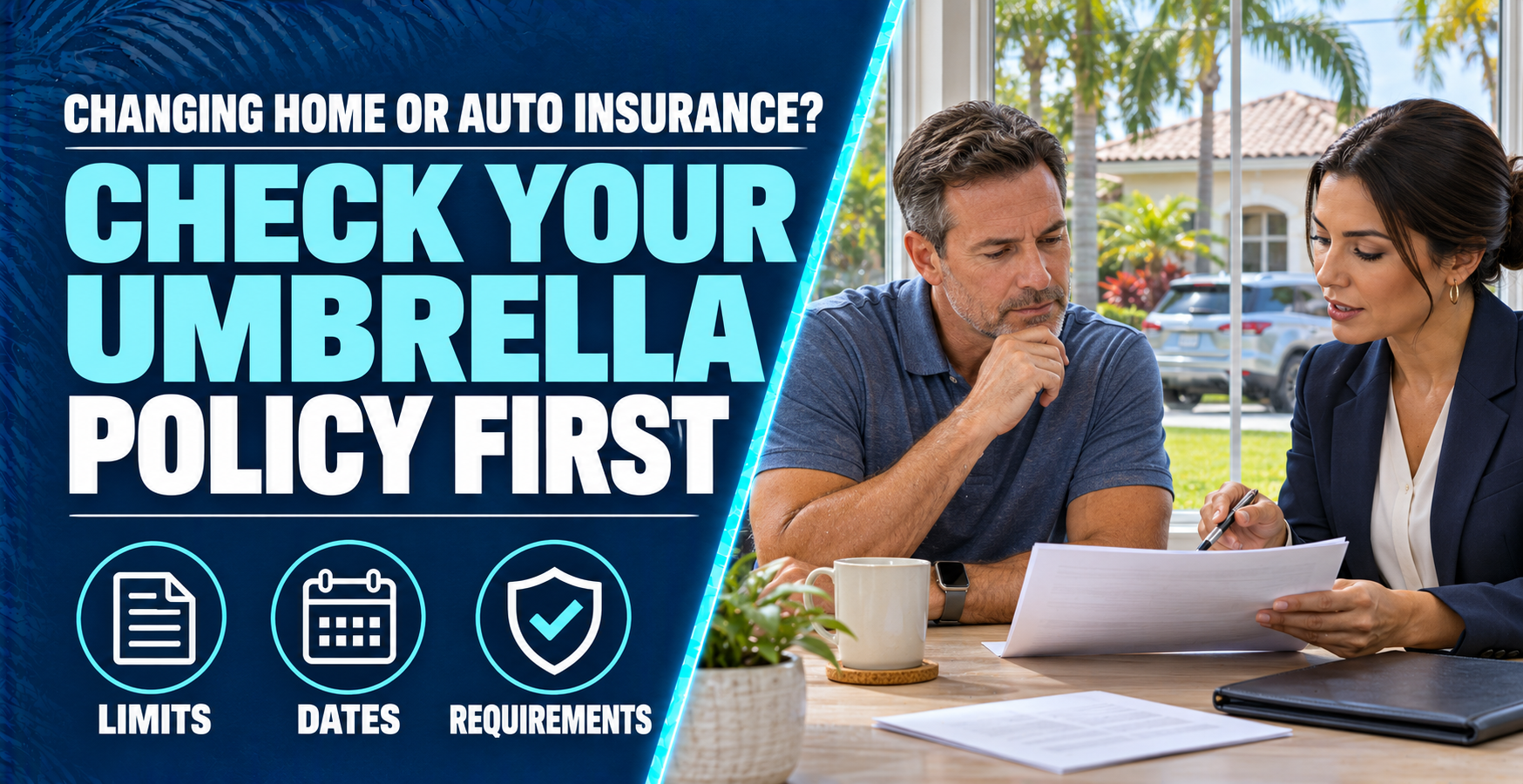
Changing Home or Auto Insurance in Florida? Review Your Umbrella Policy First
The Direct Answer
Before replacing your home or auto insurance, compare the proposed policy with your personal umbrella’s underlying insurance requirements. Ask about liability limits, acceptable insurers, covered people and properties, and any updates the umbrella insurer needs. Confirm the new coverage’s effective date and time before requesting cancellation of the old policy. A lower premium alone does not establish that the replacement fits your umbrella.
Underlying insurance means the primary coverage beneath the umbrella. The Travelers Institute explains that umbrella buyers may need specified home and auto liability limits. Your actual documents and insurer’s requirements determine what applies to you; do not assume that an umbrella automatically fills a gap created by reducing primary insurance.
For a Florida household comparing renewal offers, the useful question is practical: what changes elsewhere when this policy changes? Bring the current documents and replacement proposal to the same review. That makes it easier to discuss the full arrangement instead of comparing two prices in isolation.
1. Compare Liability Limits and Requirements, Not Just the Premium
Start with the umbrella declarations and any schedule of underlying insurance, then add the current and proposed home or auto documents. Ask the agent to identify the applicable primary liability requirements in writing. The umbrella limit and a home policy’s rebuilding amount answer different questions; one should not be used as a substitute for the other.
For an auto replacement, ask how the proposed bodily injury and property damage limits compare with the umbrella’s requirements. If the proposals describe limits differently, request a side-by-side explanation rather than assuming they are equivalent. For home insurance, identify the personal liability limit separately from dwelling coverage and property deductibles.
Illustrative scenario: a Stuart homeowner receives an auto proposal with a lower premium and chooses a lower liability limit. Before accepting it, the household sends the proposal to the umbrella agent. The review should establish whether that limit is acceptable and what changes are needed. This example does not predict a claim payment; it identifies a decision to resolve before switching.
Also ask whether the proposed primary insurer is acceptable and whether the umbrella requires any policies to be placed with a particular company. Requirements are product-specific. Keep the response with the proposal, especially when different agents handle the policies. Read about Walker’s auto insurance services and home insurance services as starting points for that conversation.
2. Check the People, Property and Activities Behind the Policies
Prepare one current household list: drivers, vehicles, residences, and any boats or recreational vehicles you want considered. Note a newly licensed driver, a different address, a vehicle replacement, or a change in how a property is used. These are review prompts, not a statement that every listed item is covered by every umbrella.
Ask who qualifies as an insured under each policy and whether the proposed arrangement needs an updated application, schedule or endorsement. Avoid treating the policyholder’s name as the entire answer. If a family member’s situation has changed, describe it accurately and ask the insurer how it affects eligibility and coverage.
Illustrative scenario: a household replaces its home policy while a college-age driver has recently changed residence. Rather than assuming the old paperwork still describes the household correctly, the family provides both facts during the review. Ask what information must be updated and request the resulting documents.
Keep the purpose of umbrella insurance clear. NAIC distinguishes liability protection from repairs to your own home or vehicle. Travelers also describes business-related losses and intentionally harmful acts among typical personal umbrella exclusions. Ask about your actual activities and wording; a personal umbrella should not be treated as universal protection for every property or business exposure.
3. Coordinate Effective Dates and Save the Final Documents
Make a short transition record showing the current policy’s planned end date and time, the replacement’s confirmed start, and the umbrella’s policy period. Ask what evidence of the replacement the umbrella insurer needs and whether an amendment is required. A quote is a proposal; request confirmation of the insurance actually issued or bound.
Do not request cancellation merely because a replacement price looks attractive. First resolve acceptance, liability requirements and timing with the responsible agent or insurer. If an adjustment remains pending, ask how to handle the transition before changing the existing arrangement.
Illustrative scenario: home and auto renew on different dates, while the umbrella renews later. Keep separate entries for each policy rather than assuming one renewal updates all three. After the change, compare the issued documents with the approved proposal and ask about discrepancies promptly.
Retain the new declarations, relevant endorsements, confirmation of any umbrella update, and cancellation documentation. If a claim or incident has already occurred, report it under the applicable policy instructions rather than treating a replacement as a way to resolve the earlier event.
Why an Independent Agency Review Helps
A coordinated conversation can expose unanswered questions between separate policies. Walker’s umbrella service page specifically describes reviewing this coverage alongside home, auto and boat insurance. Start with Walker’s umbrella insurance information, then ask which requirements apply to the arrangement you are considering. Available options and acceptance remain subject to the insurer and policy.
Questions to Bring to Walker
Ask: Which liability limits must I maintain? Is the replacement insurer acceptable? Does my household information need updating? What document confirms the change, and when does it take effect? Provide the actual proposal and existing forms so the discussion is about your policies. You can use Walker’s contact page to start the review.
FAQ
1. Can I reduce my auto liability limit because I have an umbrella?
Do not assume so. Review the umbrella’s underlying insurance requirements before reducing a limit. Ask what happens if the proposed limit is lower than required, and request a policy-specific explanation. The umbrella’s stated limit does not by itself answer where its coverage begins.
2. Must my home, auto and umbrella be with the same insurer?
Ask about the specific product rather than relying on a general rule. Before changing companies, confirm whether the proposed insurer and arrangement are acceptable to the umbrella insurer and whether policy information must be amended. An unchanged umbrella premium is not confirmation that every proposed change has been accepted.
3. Will umbrella insurance pay to repair my own car or home?
Personal umbrella insurance generally addresses liability, not damage to your own property. Review collision, comprehensive or homeowners property coverage separately. If your question concerns someone else’s injury or property damage, ask how the primary liability policy and umbrella would apply, including exclusions and conditions.
Review the Whole Arrangement Before You Switch
A useful comparison should leave you with clear requirements, coordinated dates and documents reflecting the intended coverage. Contact Walker Insurance Agency before changing a primary policy to discuss how it fits your umbrella.
REQUEST AN INSURANCE REVIEW OR QUOTE
Call +1 407-977-7100 or contact Walker online. Office: 789 SW Federal Highway, Suite 201, Stuart, FL 34994. Coverage and eligibility depend on the issued policy, underwriting and applicable terms; requesting a quote does not bind insurance.
Sources
NAIC — What’s an Umbrella Policy?
https://content.naic.org/article/whats-umbrella-policy
Travelers Institute — Insurance Essentials, personal umbrella liability section
https://www.travelers.com/iw-documents/travelers-institute/Insurance-Essentials-Guide.pdf
Travelers — Umbrella Insurance Coverage
https://www.travelers.com/umbrella-insurance
Walker Insurance Agency — Umbrella Insurance
https://www.walkerinsuranceagency.com/services/umbrella-insurance
Related Articles
NFIP Bajo una Casa Elevada: Qué Revisar en Florida
¿Guardas pertenencias bajo una casa elevada en Florida? Revisa restricciones del NFIP, cobertura de contenido y documentos antes de depender de tu seguro.
Read More →
NFIP Coverage Below Elevated Florida Homes: What to Check
Storing belongings below an elevated Florida home? Check NFIP location restrictions, contents coverage and policy details before relying on flood insurance.
Read More →
Revisa tu Umbrella Antes de Cambiar el Seguro de Casa o Auto
¿Cambias el seguro de casa o auto en Florida? Revisa límites básicos, requisitos de la aseguradora y fechas de vigencia de tu umbrella antes del cambio.
Read More →