Declined Rental Counter Coverage? Why Auto Insurance Skips Loss of Use Fees
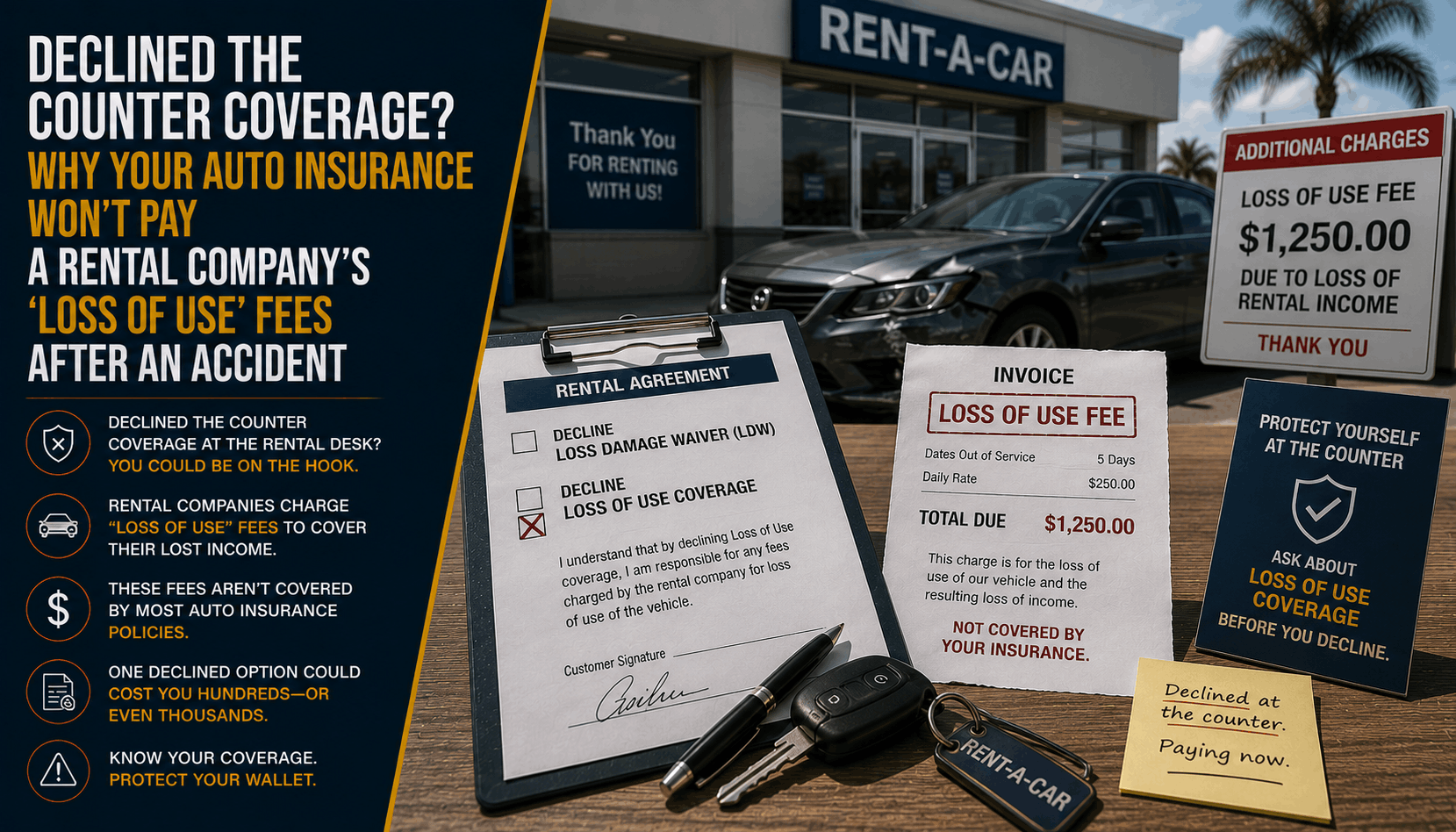
Declined the Counter Coverage? Why Your Auto Insurance Won't Pay a Rental Company's 'Loss of Use' Fees After an Accident
The Direct Answer
The short answer is declining Collision Damage Waiver (CDW) at the rental counter leaves you personally exposed to "loss of use" and administrative fees, because standard personal auto insurance policies do not automatically cover a rental fleet's lost rental revenue. When you crash a rental car, your personal auto insurance policy's collision coverage typically extends to pay for the physical repair of the vehicle (minus your deductible). However, rental car companies will also charge your credit card for Loss of Use—the daily income they claim to lose while the car sits in a repair shop—along with steep claim administration fees and diminution of value. Standard personal auto policies exclude these indirect business losses unless your insurer can verify fleet utilization rates or your policy contains specific rental agreement endorsements. Without counter waiver protection, secondary credit card coverage, or specialized policy terms, the rental agency will demand thousands of dollars directly from your bank account.
Standing at a rental car counter, most drivers confidently decline the optional Collision Damage Waiver (CDW) or Loss Damage Waiver (LDW). It feels like a smart financial move—after all, your personal auto insurance policy transfers collision and comprehensive coverage to rental vehicles in the U.S., and your credit card might offer secondary protection.
However, if you get into an accident, a major financial blind spot emerges once the vehicle is delivered to a body shop. While your insurance company negotiates physical repair bills with the repair facility, the rental car company sends you an invoice for the daily revenue that car would have earned while off the road. Understanding why your auto policy rejects this fee—and how to safeguard your savings—is crucial before your next trip.
1. Physical Damage vs. Rental Company "Loss of Use"
To understand why insurance carriers refuse to pay these claims, you must distinguish between two very different definitions of "loss of use":
- Rental Reimbursement on Your Personal Policy: On your personal auto policy, "Loss of Use" or "Rental Reimbursement" pays for your temporary transportation (a rental car or ride-share credit) while your personal car is in the shop after a covered accident.
- Loss of Use on a Rental Contract: On a rental agreement, "Loss of Use" refers to the daily income the rental agency loses because their asset is sitting in a repair shop.
When you decline counter coverage, you agree via the rental contract terms to indemnify the rental company for every single day that vehicle remains out of service, usually calculated at its full daily rack rate.
2. Why Personal Auto Insurance Rejects Fleet Downtime Claims
Insurance contracts pay for actual, proven physical losses. They do not pay speculative business expenses without strict legal proof.
Insurers reject rental company Loss of Use charges for three primary reasons:
- Failure to Prove Fleet Utilization: Insurance adjusters take the position that a rental company only suffers a true financial loss if every other car of that class in their fleet was rented out while the damaged car was being repaired. If the rental location had 20 other similar sedans sitting unrented on the lot, the insurer argues no actual revenue was lost.
- Refusal to Provide Fleet Logs: Rental companies routinely refuse to hand over confidential fleet utilization logs or internal reservation records to insurance adjusters. Without documentary proof of 100% fleet utilization, personal auto insurers deny the claim.
- Excluded Administrative Fees: Rental agencies also tack on $150 to $500+ in "administrative processing fees" and claims handling charges. Personal auto policies strictly limit payouts to physical repair costs and exclude contract-based administrative penalties.
Crucial Reality: Because the rental agreement gives the company authority to charge your credit card on file for damage and downtime, the rental agency will simply charge your card directly for unpaid Loss of Use fees—leaving you stuck in the middle of a battle between the rental company and your insurer.
3. How to Protect Yourself When Renting a Vehicle
You don't necessarily have to buy expensive counter coverage every time you travel, but you must verify your layer of protection before hitting the road:
- Step 1: Check Credit Card Coverage Provisions. Primary credit card rental coverage (available on select premium travel credit cards) often covers rental company Loss of Use and administrative fees. Secondary credit card coverage may only pay after your personal auto insurance pays.
- Step 2: Review Personal Auto Endorsements. Check if your auto policy allows for rental vehicle contract fee protection or specialized physical damage transfer endorsements that include rental fleet downtime.
- Step 3: Consider Third-Party or Counter Waivers for High-Risk Trips. If you are traveling for business, driving luxury rental vehicles, or renting internationally, purchasing a Loss Damage Waiver (LDW) at the counter or securing standalone rental insurance eliminates all personal liability for loss of use and administrative fees.
Why Working with an Independent Agency Is Vital
Understanding how personal insurance transfers to rental contracts requires specialized policy knowledge. At Walker Insurance Agency, we help drivers understand the boundaries of their auto coverage so they never face unexpected out-of-pocket charges.
The Walker Advantage:
- Policy Reviews: We audit your personal auto policy to explain exactly what is covered—and what isn't—when you rent a vehicle.
- Tailored Coverage Advice: We recommend specific policy endorsements or travel protections based on your driving habits and travel frequency.
- Local Florida Expertise: Based in Stuart, FL, we provide personal, local service to help you navigate complex claims and insurance questions.
FAQ
1. Does my personal auto insurance deductible apply to a rental car accident?
Yes. If you rely on your personal auto collision coverage for a rental car crash, your standard policy deductible (e.g., $500 or $1,000) applies. You must pay this deductible out of pocket before your insurance pays for the repairs.
2. Will my credit card cover Loss of Use fees if I decline counter coverage?
It depends on the card. Premium travel credit cards that offer primary auto rental collision coverage often explicitly cover loss of use and administrative fees, provided you paid for the full rental with that card and declined the counter waiver. Basic credit cards with secondary coverage may refuse to pay loss of use if your primary auto insurer rejects the charges.
3. What should I do if a rental company charges my credit card for Loss of Use?
Request itemized documentation from the rental company, including the repair facility's start and end dates, the daily rate charged, and fleet utilization logs proving no comparable vehicles were available. Submit these documents to your insurance carrier or credit card coverage administrator to dispute or negotiate the charges.
Drive with Complete Confidence
Don't wait for a rental car billing dispute to find out where your auto insurance coverage ends. Reviewing your policy terms ensures you can travel without worrying about surprise counter fees or out-of-pocket downtime charges.
Take control of your insurance protection today. Contact Walker Insurance Agency for a personalized auto insurance review. We provide the guidance you need to travel safely and keep your savings secure.
[GET A FREE QUOTE TODAY]
Call our personal lines division at +1-407-977-7100 or visit our office at 789 SW Federal Hwy, Ste 201, Stuart, FL 34994. Let us safeguard your drive today.
Related Articles

Seguro Comercial en Florida: Paneles Solares y Pérdida de Energía (2026)
¿Instalaste paneles solares en tu edificio en Florida? Descubre por qué el seguro comercial estándar deniega la carga en techo, ráfagas y pérdida de energía en 2026.
Read More →
Florida Commercial Solar Insurance: Roof Load & Panel Claims
Installed commercial solar in Florida? Learn why standard property insurance denies roof load, wind uplift, and panel claims, and how to stay protected.
Read More →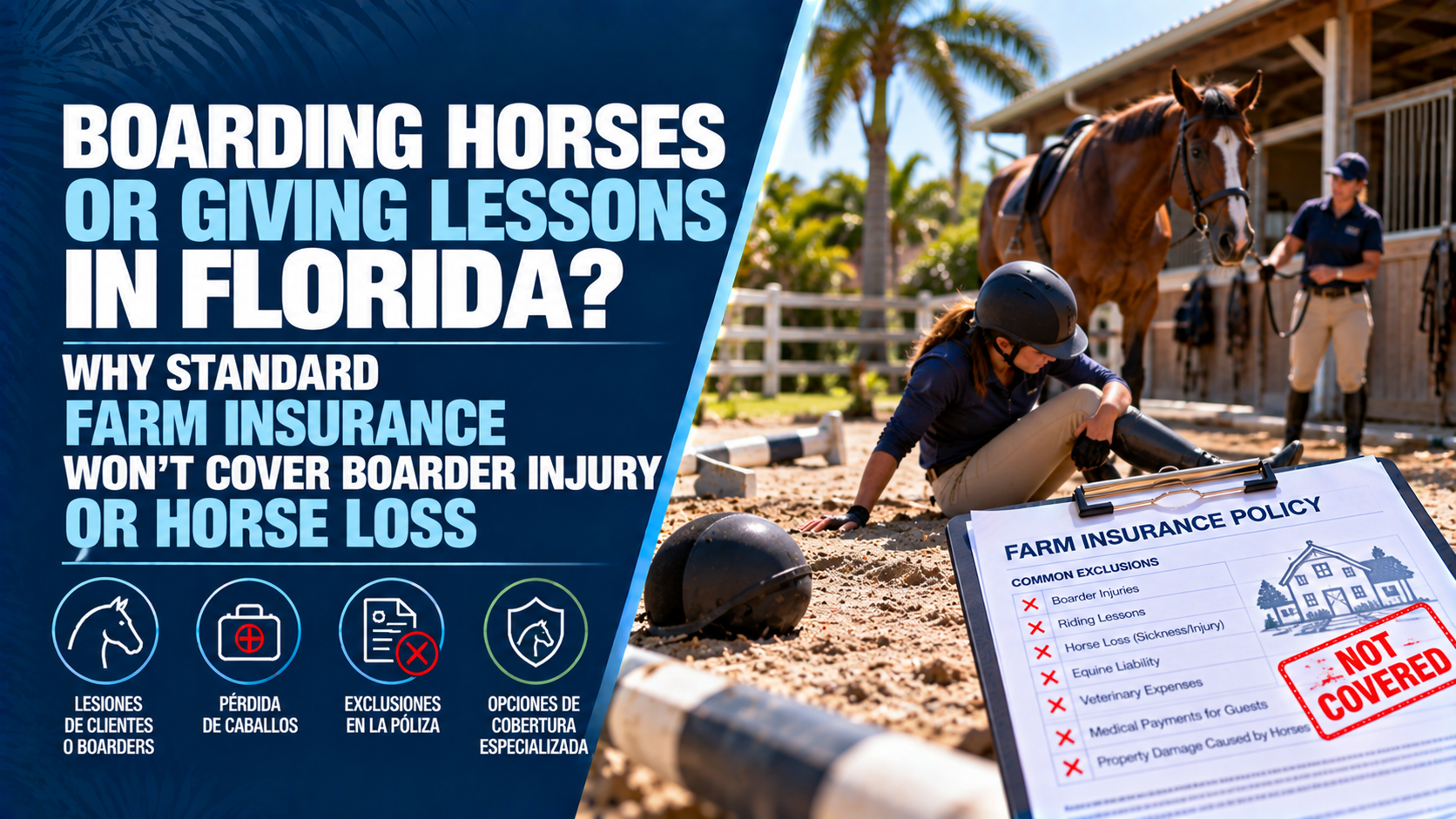
Horse Boarding Insurance in Florida: Boarder Injury & Horse Loss
Boarding horses or giving riding lessons in Florida? Learn why standard farm insurance may not cover boarder injuries, horse losses, or equine liability.
Read More →