Filing an NFIP Flood Claim in Florida: The 60-Day Proof of Loss Rule
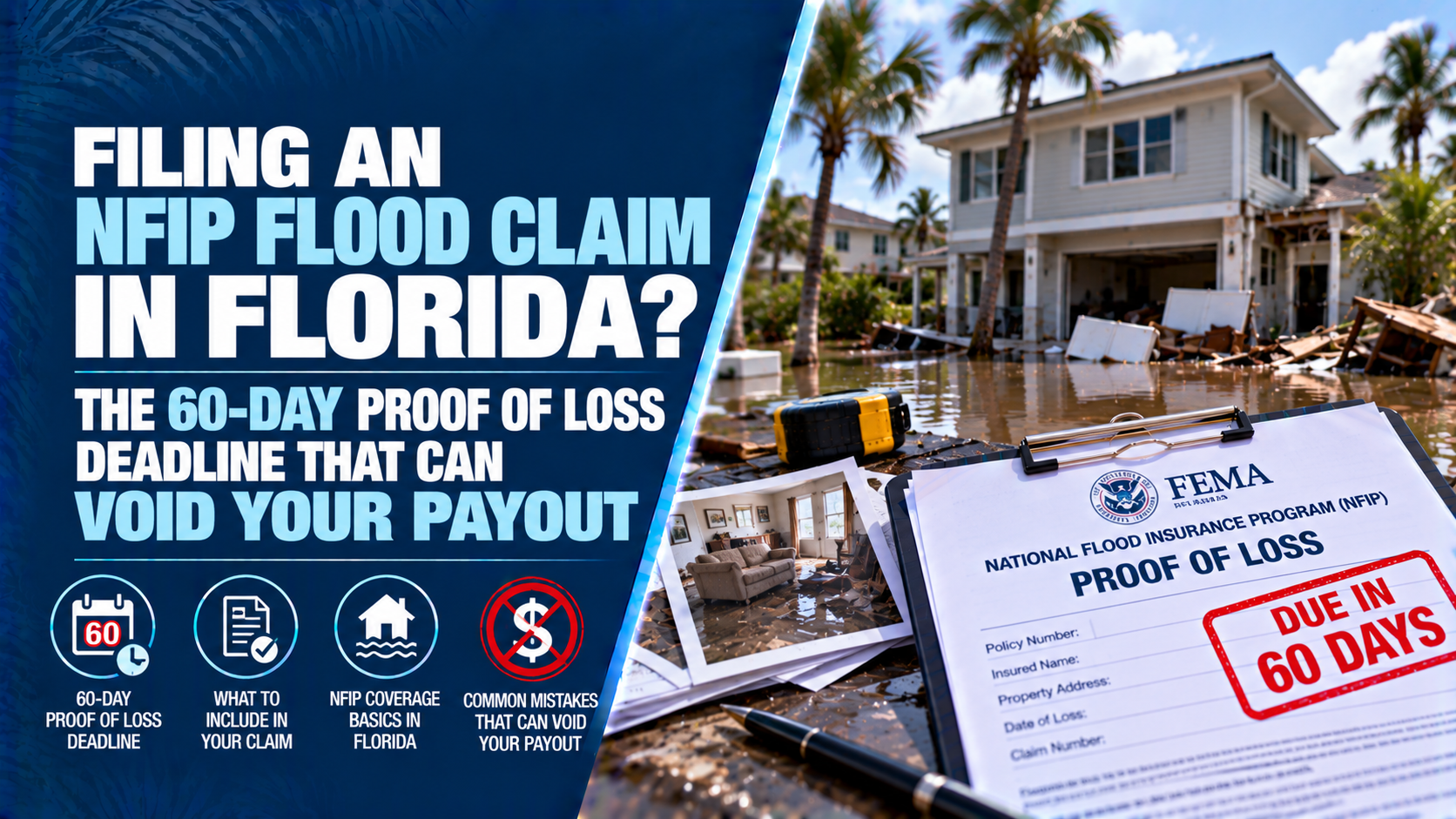
Filing an NFIP Flood Claim in Florida? The 60-Day Proof of Loss Deadline That Can Void Your Payout
The Direct Answer
Here is a critical legal rule for Florida property owners navigating flood recovery: if your home or commercial building suffers flood damage and you are insured under the National Flood Insurance Program (NFIP), federal law strictly requires you to submit a signed, sworn Proof of Loss within 60 calendar days of the flood event. Missing or improperly submitting this federal document will automatically void your right to receive any insurance payout, regardless of how severe your damage is.
Unlike standard Florida home or commercial windstorm claims governed by state insurance laws, NFIP flood policies are federally regulated by the Federal Emergency Management Agency (FEMA).
Many property owners make the catastrophic mistake of assuming that the adjuster assigned by their carrier handles the entire process or that an adjuster's inspection report replaces the official Proof of Loss.
Under the Standard Flood Insurance Policy (SFIP), the legal responsibility to complete, substantiate with evidence, and submit the sworn Proof of Loss prior to the 60th day falls solely on the policyholder. Without this form submitted on time, FEMA legally prohibits the insurer from issuing claim funds.
Surviving a flood and witnessing severe rising water damage to your residence or business is devastating. Understanding the strict technical requirements and inflexible deadlines of the NFIP is essential to securing the payout needed to rebuild.
1. What Is an NFIP Proof of Loss and Why Is It Crucial?
The Proof of Loss is a formal, legal document backed by the federal government (an official FEMA form) in which you formally declare, under penalty of perjury, the exact dollar amount you are claiming for building and personal property damage.
- It Is a Federal Sworn Statement: It is not a basic claim notice or repair quote. It must include your notarized or sworn signature along with an itemized financial breakdown of loss totals.
- Independent of the Insurance Adjuster: Although the insurance company's assigned adjuster gathers photos and prepares an estimate as a courtesy, federal law dictates that the adjuster does not file the Proof of Loss for you and lacks the legal authority to approve your claim.
- Zero Tolerance for Errors or Delays: If the document contains math errors, lacks required signatures, or arrives on day 61 without an official written extension authorized by FEMA, the claim is legally barred and denied.
2. NFIP Flood Claims (Federal) vs. Standard Home Insurance Claims (State)
Understanding the distinction between federal flood insurance and standard homeowners insurance prevents costly mistakes during the claims process:
- NFIP Flood Policy (FEMA / Federal): Governed strictly by federal statutes requiring the sworn Proof of Loss form within 60 exact days of the loss. Florida state insurance laws and bad-faith statutes do not apply.
- Standard Homeowners / Commercial Policy (HO-3 / CP 00 10 / State): Governed by Florida state law for wind, hail, or hurricane damage. Notice requirements and documentation deadlines follow state statutes and private carrier policy terms.
- Exceptional FEMA Extensions: Following major widespread disasters, FEMA may issue official bulletins extending the 60-day deadline to 120 or 180 days. However, you must never assume an extension exists unless an official written bulletin explicitly applies to your flood event and county.
3. Mandatory Documentation Required for the Proof of Loss
For a Proof of Loss to be validly accepted by the NFIP before the 60-day window closes, it must include the following supporting evidence:
- Completed Official FEMA Form: Signed by the policyholder and sworn to with exact details regarding policy number, date of loss, and property location.
- Detailed Repair Estimate (Scope of Loss): An itemized line-by-line breakdown from a licensed contractor or adjuster detailing square footage, materials, and labor costs.
- Itemized Personal Property Inventory: A detailed contents log of damaged furniture, appliances, and personal belongings—including brand, model, serial numbers, age, and high-resolution photos showing rising water damage.
- Proof of Timely Delivery: Verifiable documentation proving the package was physically delivered to the carrier before the 60-day deadline (such as certified mail receipts or carrier portal confirmations).
4. Strategic Steps to Prevent Flood Claim Denials
Ensuring your flood insurance claim is paid in full requires following four essential steps in 2026:
- Request the Official Proof of Loss Form Immediately: Obtain the official FEMA Proof of Loss form from your carrier or agent as soon as you report the flood loss.
- Document Thoroughly Before Cleaning or Disposal: Take detailed photos and videos of the flood waterlines on walls, structural damage, and ruined contents before throwing anything away. Retain physical samples of carpet or drywall for the adjuster.
- Obtain Independent Local Contractor Quotes Promptly: Do not rely solely on the adjuster's initial estimate; secure independent contractor bids to support the exact dollar figure declared on your Proof of Loss.
- Submit Supplemental Claims on Time: If you discover hidden flood damage during repairs, you must submit a Supplemental Proof of Loss backed by documentation within the statutory deadline or approved FEMA extension.
Why Working with an Independent Agency Matters
Navigating strict FEMA mandates, coordinating flood adjusters, and managing NFIP deadlines requires specialized technical expertise. At Walker Insurance Agency, we assist Florida homeowners and business owners in protecting their flood claims from start to finish.
- Pre-Storm Coverage Audits: We evaluate your NFIP and private flood insurance options to ensure building and contents limits match your true exposure before hurricane season starts.
- Step-by-Step Claim Guidance: We assist policyholders in organizing required FEMA documentation to help ensure Proof of Loss files are structured accurately.
- Integrated Property Coverage: We design comprehensive insurance portfolios that align your standard home or commercial policy with your flood insurance to eliminate gaps between wind and water coverage.
Frequently Asked Questions
1. What if the NFIP adjuster has not visited my home and the 60-day deadline is approaching?
You must complete, sign, and submit your own sworn Proof of Loss using a good-faith estimate based on contractor quotes and photos prior to day 60. Do not wait for the adjuster; meeting the legal deadline is strictly the policyholder's responsibility.
2. Does the NFIP policy cover home elevation or demolition costs?
Yes. Through Increased Cost of Compliance (ICC) coverage, an NFIP policy provides up to $30,000 in additional funds to elevate, demolish, or relocate a structure that has suffered substantial flood damage to comply with local floodplain codes. ICC coverage requires its own separate Proof of Loss submission.
3. Does flood insurance cover personal contents located in a basement?
The NFIP enforces severe coverage restrictions for areas defined as "basements" or sub-grade enclosure floors. The policy covers essential building equipment (such as water heaters, electrical panels, and HVAC systems) but excludes most personal belongings, finished walls, or furniture in those lower areas.
Protect Your Flood Policy and Recovery Today
Don't let a missed 60-day administrative deadline void your flood insurance payout after a storm. Strict compliance with NFIP Proof of Loss rules ensures you receive the funds needed to rebuild your home or commercial facility in 2026.
Keep your property, your financial investment, and your family's future fully protected. Contact Walker Insurance Agency today for a fast, zero-pressure flood and home insurance review.
[GET A FREE FLORIDA FLOOD INSURANCE QUOTE TODAY]
Call our insurance team at +1-407-977-7100 or visit our office at 789 SW Federal Hwy, Ste 201, Stuart, FL 34994. We are always ready to help you navigate Florida insurance options and protect your property.
Related Articles
Seguro de Casa en Florida: Cláusula de Desocupación de 60 Días
¿Casa vacía en Florida por más de 60 días tras un huracán? Descubre por qué el seguro puede denegar reclamos por robo o fugas de agua en 2026.
Read More →
Florida Home Insurance: 60-Day Vacancy Clause & Hurricanes
Living away from your Florida home or second property after a hurricane? Learn how the 60-day vacancy clause can lead to denied insurance claims.
Read More →
Plazo de Prueba de Pérdida (Proof of Loss) NFIP en Florida (2026)
¿Cuál es el límite para entregar la Declaración Jurada de Pérdida (Proof of Loss) del seguro de inundación NFIP en Florida tras un huracán en 2026? Descubre los 60 días clave.
Read More →