Florida Home Insurance: 60-Day Vacancy Clause & Hurricanes
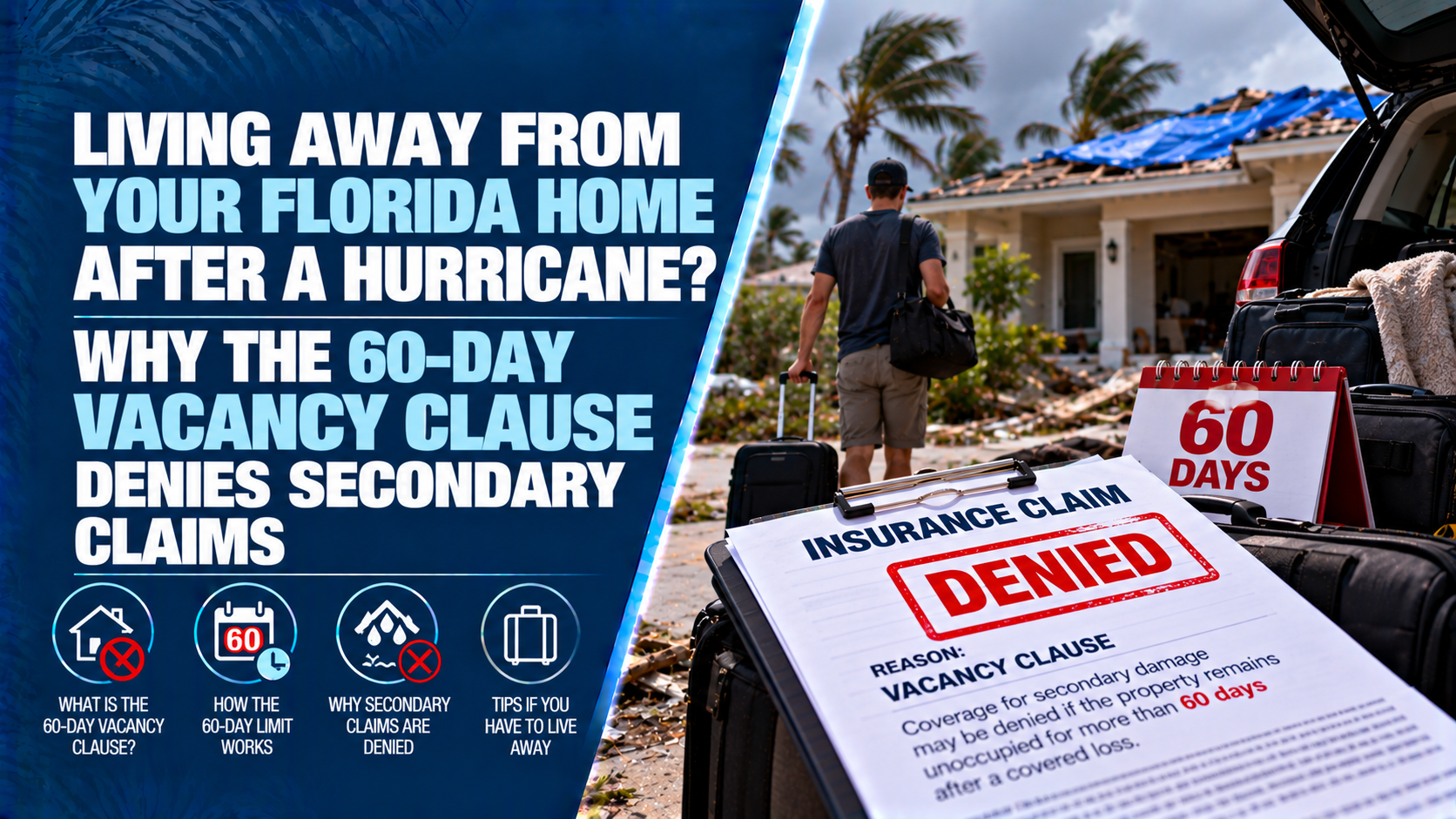
Living Away from Your Florida Home After a Hurricane? Why the 60-Day Vacancy Clause Denies Secondary Claims
The Direct Answer
Here is a major coverage trap facing seasonal residents, snowbirds, and displaced owners in Florida: if your primary dwelling, secondary home, or vacation property remains vacant or unoccupied for more than 30 to 60 consecutive days, your standard homeowners insurance policy (HO-3 or HO-6) may suspend or restrict critical coverage—denying subsequent claims for water damage, vandalism, theft, or frozen/burst pipes.
Following a major hurricane, many homeowners evacuate, temporarily relocate to secondary residences, or leave seasonal properties empty while waiting for adjusters, materials, or contractors.
However, insurance carriers view unoccupied or vacant homes as significantly higher risks. If a secondary pipe leak, roof failure, or break-in occurs while the home has been empty past the policy’s Vacancy or Unoccupancy Clause limit (typically 30 or 60 days), your insurer can legally deny the secondary claim entirely.
Understanding how insurance contracts define vacancy versus unoccupancy—and how to properly protect an unattended property—is essential to ensuring your Florida home remains fully insured during long-term displacement or seasonal absences.
Evacuating after a storm or returning to a secondary home up north brings relief, but discovering months later that an undetected leak or secondary damage occurred while you were away—only to have your carrier deny the claim due to a vacancy clause—can turn a manageable situation into a massive financial loss.
1. Vacancy vs. Unoccupancy: Understanding the Legal Definitions
Insurance policies strictly differentiate between a home that is "unoccupied" and one that is legally "vacant." Both conditions can trigger coverage restrictions after a set period:
- Unoccupied Status: The dwelling contains personal belongings, furniture, and appliances suitable for daily living, but the occupants are temporarily residing elsewhere (e.g., snowbirds living up north or owners displaced during post-hurricane repairs).
- Vacant Status: The dwelling lacks sufficient furniture, bedding, or basic amenities necessary for human habitation.
- The 30 to 60-Day Trigger: Standard insurance forms (such as ISO HO-3 contracts) explicitly state that if a dwelling is vacant or unoccupied for more than 30 or 60 consecutive days prior to a loss, specific coverages—including vandalism, malicious mischief, water discharge/leakage, and glass breakage—are automatically suspended or excluded.
2. Standard Homeowners Policy vs. Vacant Home Insurance / Endorsements
Comparing a standard policy against specialized vacant property coverage shows how unmanaged extended absences create severe claim gaps:
- Standard Homeowners Policy (HO-3): Excludes losses caused by water leaks, vandalism, or theft if the home is empty past 30 to 60 days; imposes higher deductibles; and may void coverage if the home is deemed abandoned.
- Vacant / Unoccupied Home Endorsement or Permitted Vacancy Rider: Maintains full property damage protection during extended absences, removes the 30/60-day exclusion clause, and covers water leaks and property damage while repairs or seasonal absences take place.
3. Essential Coverages & Steps for Unattended Florida Properties
To safeguard a vacant or unoccupied secondary home, vacation property, or storm-damaged house, implement these key protection strategies:
- Secure a Vacant Home Insurance Policy or Rider: If you will be living away from your property for more than 30 to 60 days, notify your independent agent to add a Permitted Vacancy Endorsement or transition to a specialized Vacant Home Policy.
- Install Smart Water Shut-off Valves and Sensors: Insurance carriers often require or incentivize automatic main water shut-off systems and connected leak detectors that alert your smartphone if a pipe bursts while you are away.
- Hire a Home Watch Service: Retain a licensed home watch professional or trusted neighbor to inspect the property weekly, log visits, and maintain regular records showing the home is monitored.
- Maintain Climate Control & Security Systems: Keep air conditioning running (set to 75°F–78°F) to prevent catastrophic mold growth—a common Florida post-storm risk—and maintain active security alarms and exterior lighting.
4. How to Safely Manage a Property During Long-Term Repairs
Protecting your home and insurance validity while living away during storm restoration involves three proactive steps:
- Notify Your Insurance Company in Writing: Inform your carrier or independent agent if post-hurricane repairs will keep you out of the home for longer than 30 days.
- Keep Continuous Utilities Active: Do not turn off electricity or water completely unless advised by a licensed contractor; active AC prevents internal humidity and toxic mold blooms.
- Document Property Preservation Efforts: Save invoices from home watch inspections, contractor activity logs, and utility bills to prove to your adjuster that the property was actively maintained rather than abandoned.
Why Working with an Independent Agency Matters
Navigating post-hurricane displacement rules, vacancy clauses, and seasonal home coverage in Florida requires local expertise. At Walker Insurance Agency, we specialize in customizing personal property solutions for Florida homeowners, snowbirds, and real estate investors.
- Vacancy & Unoccupancy Audits: We review your policy terms to identify hidden time limits and ensure your property remains protected during extended absences or repairs.
- Specialty Vacant & Secondary Home Carriers: We partner with premier insurance carriers offering flexible vacant home riders, seasonal endorsements, and broad property damage coverage.
- Proactive Claims & Risk Guidance: We help you structure policy endorsements before long departures to prevent costly claim denials down the road.
Frequently Asked Questions
1. Does my standard home insurance cover mold if my Florida home is empty for two months?
Most standard policies limit mold coverage (often capped at $10,000) and require policyholders to take reasonable steps to prevent it. If mold develops because the AC was turned off while the home was unoccupied for over 30 to 60 days, the insurer may deny the mold claim for neglect or vacancy clause violations.
2. Can I avoid the vacancy clause by having a neighbor check my mail?
Having a neighbor check mail or pick up packages helps security, but it does not legally change an "unoccupied" or "vacant" status under insurance contract language. To maintain coverage legally, you must notify your carrier and secure a vacancy endorsement or specialized policy.
3. Does the 60-day vacancy rule apply if I am forced out due to hurricane repairs?
If your home is uninhabitable strictly due to a covered hurricane loss, carriers usually grant latitude during active repairs. However, you must maintain ongoing communication with your insurer and contractor. If repairs stall and the home sits unattended for months without active construction, the carrier can invoke vacancy restrictions on secondary losses (like theft or new leaks).
Protect Your Unattended Property Today
Don't wait for a secondary water leak or break-in to discover that living away from your Florida home triggered a 60-day vacancy exclusion. Securing the proper vacancy endorsement ensures your investment remains completely protected whether you are home or away.
Keep your home, your secondary properties, and your financial security secure. Contact Walker Insurance Agency today for a fast, zero-pressure policy review and coverage audit.
[GET A FREE FLORIDA HOME INSURANCE QUOTE TODAY]
Call our home insurance team at +1-407-977-7100 or visit our office at 789 SW Federal Hwy, Ste 201, Stuart, FL 34994. We are always ready to help you navigate Florida insurance options and protect your property.
Related Articles
Seguro de Casa en Florida: Cláusula de Desocupación de 60 Días
¿Casa vacía en Florida por más de 60 días tras un huracán? Descubre por qué el seguro puede denegar reclamos por robo o fugas de agua en 2026.
Read More →
Plazo de Prueba de Pérdida (Proof of Loss) NFIP en Florida (2026)
¿Cuál es el límite para entregar la Declaración Jurada de Pérdida (Proof of Loss) del seguro de inundación NFIP en Florida tras un huracán en 2026? Descubre los 60 días clave.
Read More →
Filing an NFIP Flood Claim in Florida: The 60-Day Proof of Loss Rule
Filing an NFIP flood insurance claim in Florida? Learn why missing the strict 60-day Proof of Loss deadline can void your payout in 2026.
Read More →