Florida Hurricane Solar Panel Insurance Claims: Limits & Caps 2026
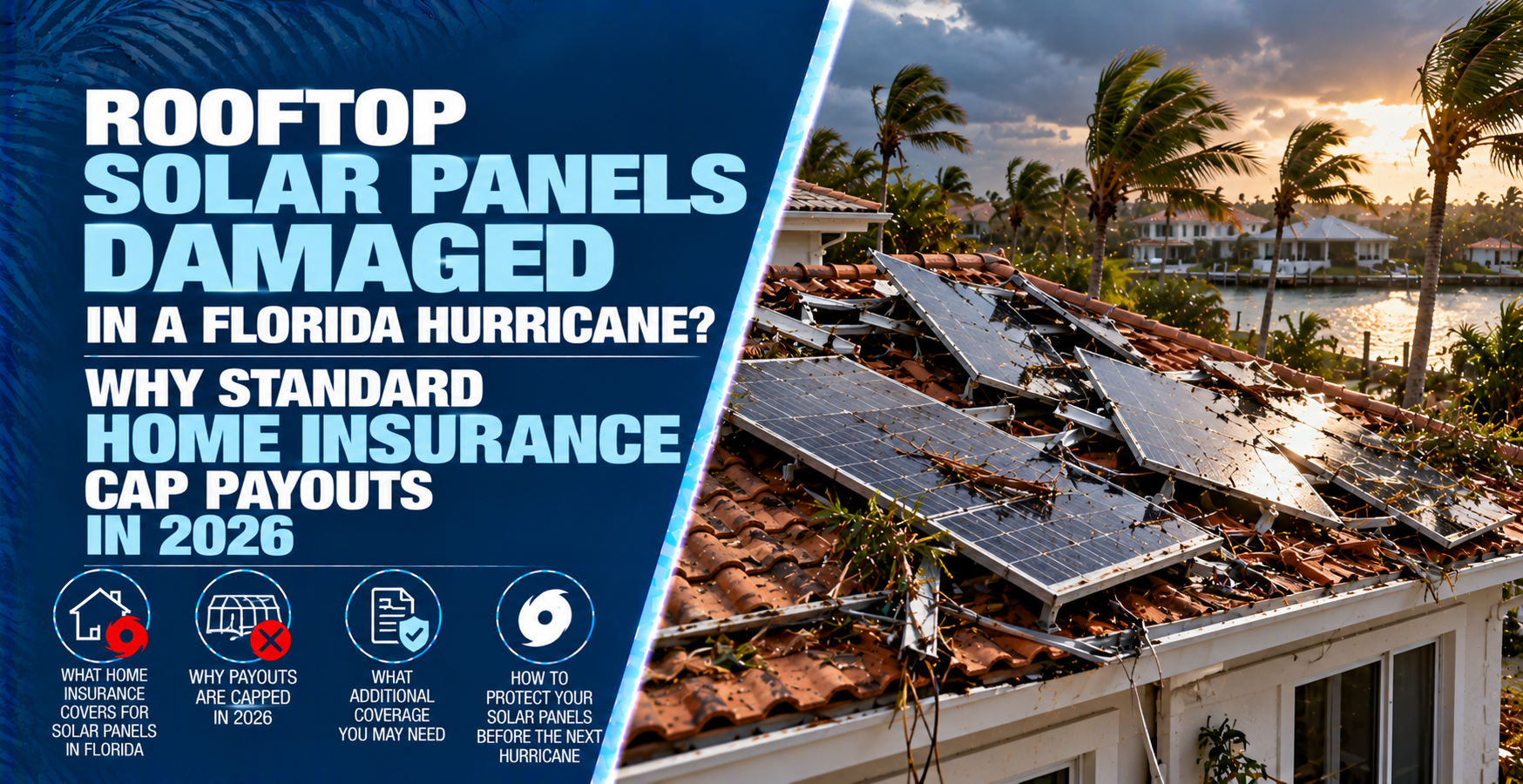
Rooftop Solar Panels Damaged in a Florida Hurricane? Why Standard Home Insurance Caps Payouts in 2026
The Direct Answer
Here is a major financial risk facing Florida homeowners adopting clean energy: while roof-mounted solar panels are typically classified under Coverage A (Dwelling) on standard homeowners insurance policies, insurers frequently cap payouts, enforce high hurricane deductibles, apply strict sub-limits, or deny coverage altogether if the system was installed without prior notice or proper policy endorsements.
Following severe tropical storms and hurricanes in Florida, homeowners often discover that their $20,000 to $40,000 rooftop photovoltaic (PV) array is not fully protected.
When high winds detach panel racking, destroy solar cells, or break structural seals on the roof deck, policyholders face severe claim shortfalls.
Insurers may enforce separate solar sub-limits, refuse to pay for the mandatory "detach and reset" labor required during roof repairs, or dispute claims based on system ownership (leased vs. owned) and pre-storm roof age.
Understanding how Florida property insurance policies treat solar equipment—and how to structure your limits before storm season arrives—is essential to preventing massive out-of-pocket losses after a storm.
Investing in solar power lowers energy bills, but recovering from hurricane damage requires knowing how policy caps, utility tier rules, and coverage exclusions apply under Florida insurance guidelines.
1. How Standard Home Insurance Handles Solar Panel Claims
In Florida, the way your insurance policy treats solar damage depends heavily on mounting location, ownership structure, and system size:
- Roof-Mounted Arrays (Coverage A - Dwelling): Permanently attached rooftop panels are generally treated as part of the primary dwelling structure. However, if your overall Coverage A limit was not increased after installation, your total dwelling coverage may be insufficient to rebuild both your house and the solar array.
- Ground-Mounted or Detached Arrays (Coverage B - Other Structures): Panels installed on ground racks, detached garages, or pergolas are classified under Coverage B (Other Structures). Standard Coverage B limits are capped at 10% of Coverage A, which frequently fails to cover the full replacement cost of ground-based solar systems.
- Leased Systems vs. Owned Systems: If you lease your solar system or participate in a Power Purchase Agreement (PPA), your homeowners policy may exclude physical panel coverage entirely, shifting responsibility to the solar leasing company’s third-party policy. However, if hurricane winds tear leased panels off your roof, your home policy must still address the resulting roof deck punctures.
- Utility Tier Insurance Requirements: Florida utilities (like FPL, Duke Energy, and TECO) mandate specific personal liability insurance limits based on system capacity. Tier 2 systems (10 kW to 100 kW) legally require a minimum of $1 million in personal liability coverage before net metering approval.
2. The Hidden Cost: "Detach & Reset" During Roof Replacement
A common insurance trap involving rooftop solar panels after a hurricane is the Detach and Reset (D&R) expense.
When hurricane winds damage the underlying roof deck, the entire solar array must be professionally uninstalled, stored safely, and reinstalled after the new roof is completed.
- High Out-of-Pocket Labor Costs: Disassembling and reinstalling a residential solar array routinely costs between $3,000 and $8,000+ in specialized electrician and roofing labor.
- The Insurance Carrier Denial: Many standard insurance carriers attempt to exclude or cap D&R costs, claiming the panels themselves show no physical storm damage, even though removing them is structurally necessary to fix the covered roof loss.
- Roof Workmanship Warranties: Utilizing unauthorized contractors to move panels during insurance repairs can instantly void both your solar installer’s workmanship warranty and your roof’s leak protection warranty.
3. Standard Coverage vs. Enhanced Solar Endorsement Protection
Comparing a basic home insurance policy against an enhanced solar-protected policy highlights the gap in claim payouts after a hurricane:
- Dwelling Limit (Coverage A): Standard policies cap coverage at the original home value, ignoring the added equity of the solar system. Enhanced policies adjust Coverage A upward to reflect the full replacement value of both the house and the panel system.
- Hurricane Deductible: Standard policies apply a percentage-based deductible (typically 2% to 10% of total Coverage A) across the combined loss. Enhanced policies ensure solar values are correctly integrated into this threshold without triggering separate structural sub-limits.
- Inverter & Electrical Surge Damage: Standard policies exclude electrical or mechanical breakdown failures. Enhanced policies include an Equipment Breakdown Endorsement to cover micro-inverters, power walls, and control panels damaged by storm surges or grid spikes.
- Detach & Reset Labor: Standard policies often dispute or cap removal costs if panels are physically undamaged. Enhanced policies explicitly cover D&R as a necessary expense of covered structural roof repairs.
4. Essential Steps to Safeguard Your Solar Investment in 2026
To ensure your solar array is fully protected against Florida hurricanes, follow these four proactive risk management steps:
- Notify Your Insurance Carrier Post-Installation: Formally disclose your solar system to your agent to ensure the array is explicitly listed on your policy declarations page.
- Increase Your Coverage A (Dwelling) Limit: Adjust your total dwelling limit upward by $25,000 to $50,000+ to match the current replacement cost of your panels, racking, and inverter systems.
- Add an Equipment Breakdown Endorsement: Secure an equipment breakdown rider (typically $25–$50/year) to cover micro-inverters, storage batteries, and control systems against storm-related power surges and electrical failures.
- Document System Baseline Condition: Take annual, high-resolution photos of your panel array, racking attachments, and roof flashings before storm season to disprove carrier claims of pre-existing wear and tear.
Why Working with an Independent Agency Matters
Navigating renewable energy underwriting rules, utility liability requirements, and coastal Florida hurricane coverages requires local market expertise. At Walker Insurance Agency, we assist Florida homeowners in structuring property coverage that protects both physical structures and green energy investments.
- Coverage & Sub-Limit Audits: We evaluate your declarations page to identify hidden solar payout caps and eliminate coverage shortfalls before storm season.
- Access to Solar-Friendly Carriers: We partner with top-rated Florida insurers offering broad dwelling limits, flexible detach-and-reset terms, and comprehensive equipment breakdown endorsements.
- Complete Property Risk Alignment: We integrate your roof, solar array, windstorm, and flood coverages into a seamless insurance strategy.
Frequently Asked Questions
1. Does my manufacturer’s warranty cover solar panel damage from a hurricane?
No. Solar panel manufacturer warranties cover product defects, early degradation, and mechanical failures under normal operating conditions. They explicitly exclude weather-related perils such as hurricane winds, flying debris impacts, or lightning strikes.
2. How does my hurricane deductible affect a solar panel claim?
In Florida, hurricane deductibles are structured as a percentage (typically 2%, 5%, or 10%) of your total Coverage A (Dwelling) limit rather than a flat dollar fee. If your Coverage A limit is $500,000 with a 5% deductible, you must pay $25,000 out of pocket before your insurer pays for roof or solar panel repairs.
3. What happens if an installer damaged my roof deck during panel installation prior to a storm?
If water intrusion or roof failure stems from poor installation rather than direct hurricane winds, your insurer may deny the claim under standard faulty workmanship exclusions. In this scenario, recovery must be pursued through your solar installer’s commercial general liability insurance or workmanship warranty.
Protect Your Solar Panels and Home Investment Today
Don't wait for a hurricane to damage your rooftop array before realizing your policy caps solar payouts. Securing proper Coverage A adjustments and equipment endorsements ensures your clean energy investment remains completely protected in 2026.
Keep your home, your solar investment, and your financial security secure. Contact Walker Insurance Agency today for a fast, zero-pressure policy and solar coverage review.
[GET A FREE FLORIDA HOME INSURANCE QUOTE TODAY]
Call our property insurance team at +1-407-977-7100 or visit our office at 789 SW Federal Hwy, Ste 201, Stuart, FL 34994. We are always ready to help you navigate Florida insurance options and protect your property.
Related Articles
Seguro de Casa Móvil en Florida: Denegación de Reclamos (2026)
¿Tu casa móvil o manufactured home sufrió daños por un huracán en Florida? Descubre por qué el seguro deniega reclamos y qué coberturas necesitas en 2026.
Read More →
Florida Hurricane Manufactured Home Insurance: Tie-Downs & Carports
Manufactured home damaged by a Florida hurricane? Learn why insurance denies tie-down, carport, and shed claims and how to secure coverage in 2026.
Read More →
Seguro de Casa en Florida: Cobertura de Paneles Solares y Huracanes (2026)
¿Se dañaron tus paneles solares por un huracán en Florida? Descubre por qué el seguro estándar limita los pagos y qué coberturas necesitas en 2026.
Read More →