The $8,000 Dealership Trap: Why "Full Coverage" Won't Pay Off Your Totaled Car Loan
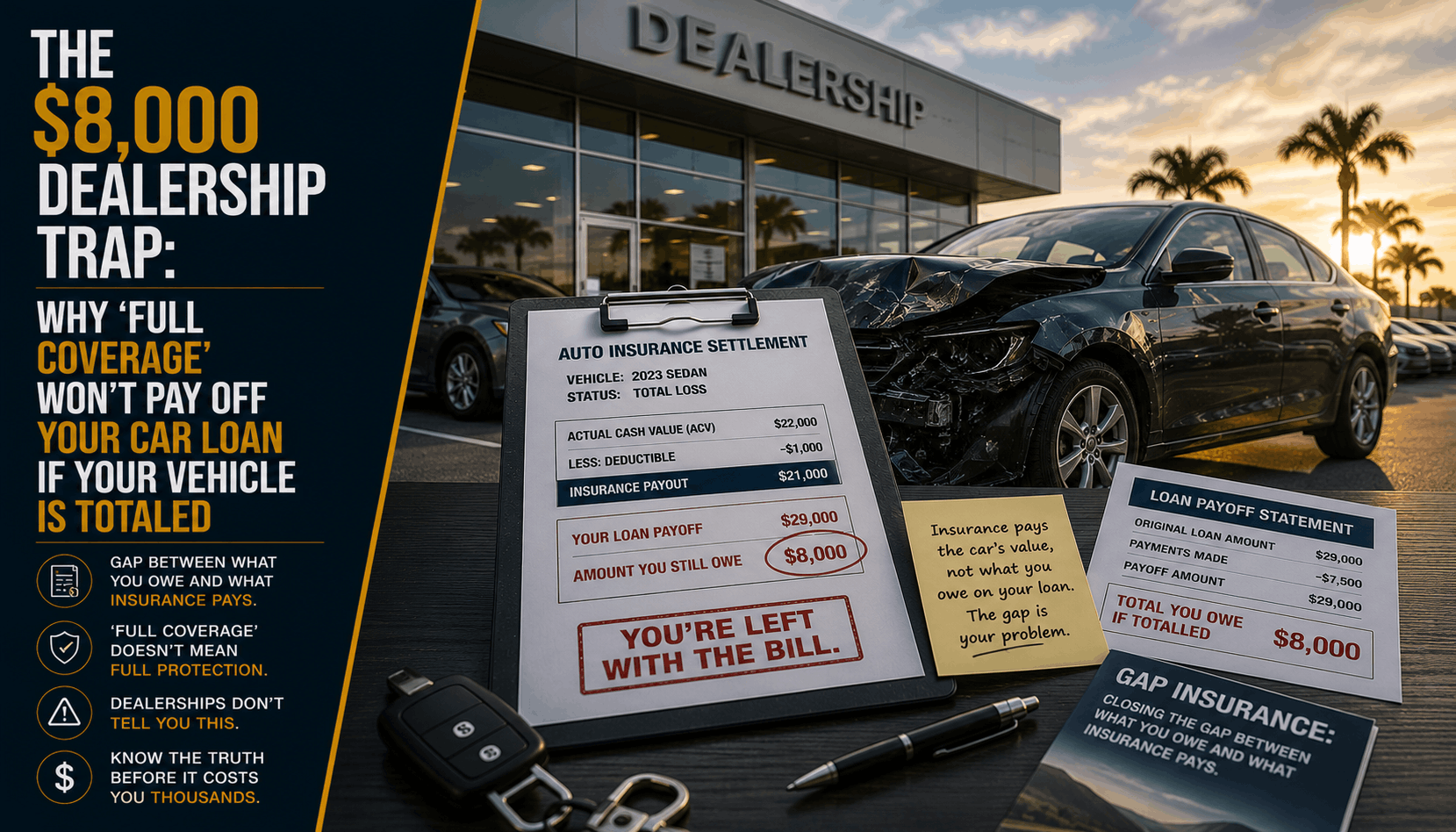
The $8,000 Dealership Trap: Why "Full Coverage" Won't Pay Off Your Car Loan If Your Vehicle Is Totaled
The Direct Answer
The short answer is absolutely not—carrying so-called "full coverage" auto insurance will not guarantee that your auto loan is paid off if your vehicle is declared a total loss. One of the most prevalent and financially devastating myths among car buyers is believing that "full coverage" (carrying comprehensive and collision policies required by lenders) pays off whatever balance remains on a financing agreement. In reality, standard auto insurance contracts pay strictly the Actual Cash Value (ACV) of the vehicle at the exact moment of the accident—never what you owe on the bank contract. Because new and used vehicles depreciate drastically faster than loan balances decrease, a driver can easily owe $28,000 on a loan for a vehicle that the insurance adjuster values at only $20,000 after an crash. This creates an $8,000 financial deficit (plus your deductible) that you must pay out of pocket to the lender immediately, even though you no longer have a car to drive.
Relying on dealership terminology or vague policy terms leaves your personal savings exposed to severe financial shock. Understanding how vehicle depreciation intersects with loan amortization is critical to protecting your balance sheet.
1. The Mechanic of the Gap: Actual Cash Value vs. Loan Balance
To understand how an $8,000 deficit occurs, you must look at how auto insurers calculate payouts versus how financial institutions structure loans:
- Actual Cash Value (ACV): Insurance policies are indemnity contracts. If your car is totaled, the insurer pays the fair market value of the vehicle immediately before the collision, accounting for mileage, wear and tear, market trends, and age.
- Rapid Vehicle Depreciation: A new car can lose 15% to 20% of its value within the first year alone. Addition of dealer fees, sales tax, extended warranties, or rolling over negative equity from a previous trade-in inflates the initial loan balance far above the car's actual market value.
- The Lender's Requirement: When a car is totaled, the loan's collateral disappears. Lenders enforce an immediate acceleration clause requiring the remaining loan balance to be paid in full immediately upon receipt of the insurance settlement check.
The math of this trap is straightforward and unforgiving:
Out-of-Pocket Deficit=Remaining Loan Balance−(Vehicle ACV−Policy Deductible)
If your loan balance is $28,000, the insurance ACV settlement is $20,000, and your deductible is $1,000, your net insurance payout is $19,000. You remain legally responsible for paying the $9,000 difference directly to your lender out of pocket.
2. Common Financing Factors That Expand the Coverage Gap
Certain financing structures significantly increase the likelihood of facing a massive out-of-pocket bill after a severe accident:
- Low Down Payments: Put down less than 10% to 20% at signing, and your loan balance starts significantly higher than the car's immediate market value.
- Extended Loan Terms (60 to 84 Months): Long loan terms reduce monthly payments by stretching principal reduction across many years. During the first half of a 72- or 84-month loan, monthly payments primarily cover interest, leaving the principal balance far higher than the vehicle's depreciated value.
- Rolled-Over Negative Equity: Carrying unpaid balances from an old car loan into a new vehicle purchase instantly creates a huge gap between the loan balance and the new vehicle's market value from day one.
3. How to Fully Protect Yourself Against the Total Loss Deficit
You do not have to leave yourself vulnerable to thousands in sudden debt if your vehicle is involved in a severe crash. Securing complete financial protection requires structuring your auto policy correctly:
- Step 1: Secure Guaranteed Asset Protection (GAP) Coverage. GAP insurance is specifically designed to cover the financial difference between your vehicle’s Actual Cash Value payout and the remaining balance on your auto loan or lease following a total loss.
- Step 2: Buy GAP Through Your Insurance Agency, Not the Dealership. Dealerships routinely roll GAP insurance into your auto financing at inflated prices (often charging $800 to $1,200+, plus interest over the loan term). Adding GAP coverage directly through your independent insurance policy typically costs a fraction of that price—often just a few dollars per month.
- Step 3: Consider New Car Replacement Endorsements. If you buy a brand-new vehicle, certain insurance carriers offer endorsements that replace your vehicle with a current model year rather than paying depreciated ACV if totaled within the first 1 to 2 years.
Why Working with an Independent Agency is Vital
Navigating complex financing clauses, loan-to-value ratios, and insurance endorsements requires specialized risk advisory. At Walker Insurance Agency, we audit your auto policy to ensure you aren't exposed to sudden dealership traps or total loss deficits.
The Walker Advantage:
- Total Loss Risk Audits: We evaluate your vehicle loans, lease terms, and current market valuations to identify potential negative equity gaps.
- Cost-Effective GAP Solutions: We offer standalone or policy-attached GAP solutions that save you hundreds compared to dealership financing markups.
- Proactive Claims Support: If a severe accident occurs, our local team works directly with claims adjusters and lenders to coordinate smooth payouts and protect your credit score.
FAQ
1. Isn't "Full Coverage" required by my auto lender?
Yes, lenders require "full coverage," but in insurance terms, "full coverage" simply means carrying Comprehensive and Collision protection alongside state-mandated liability limits. Lenders require this to protect their collateral value, but it does not include GAP insurance unless explicitly added as a separate policy endorsement.
2. Can I add GAP coverage to my insurance policy after I've already driven the car off the lot?
In most cases, yes—provided your vehicle meets carrier age and mileage eligibility guidelines and you carry comprehensive and collision coverage. Adding GAP through your insurance policy early in your loan cycle eliminates the gap before a severe crash occurs.
3. What happens to my deductible when GAP insurance pays out?
It depends on the policy structure. Many insurance-provided GAP endorsements cover up to $500 or $1,000 of your auto insurance deductible as part of the settlement, while some dealership-sold GAP policies exclude deductibles entirely. Reviewing policy terms with your agent ensures complete clarity.
Eliminate the Total Loss Gap Today
A sudden highway collision or severe storm can total your vehicle in seconds. Discovering that your "full coverage" policy leaves you with an $8,000 debt to your bank creates a severe financial crisis when you need a new car most.
Take control of your auto insurance strategy today. Contact Walker Insurance Agency for a comprehensive policy audit. We provide the technical expertise you need to close financial coverage gaps, secure affordable GAP protection, and keep your personal savings secure.
[GET A FREE QUOTE TODAY]
Call our personal lines division at +1-407-977-7100 or visit our office in Stuart, FL. Let us safeguard your property boundaries today.
Related Articles

Seguro Comercial en Florida: Paneles Solares y Pérdida de Energía (2026)
¿Instalaste paneles solares en tu edificio en Florida? Descubre por qué el seguro comercial estándar deniega la carga en techo, ráfagas y pérdida de energía en 2026.
Read More →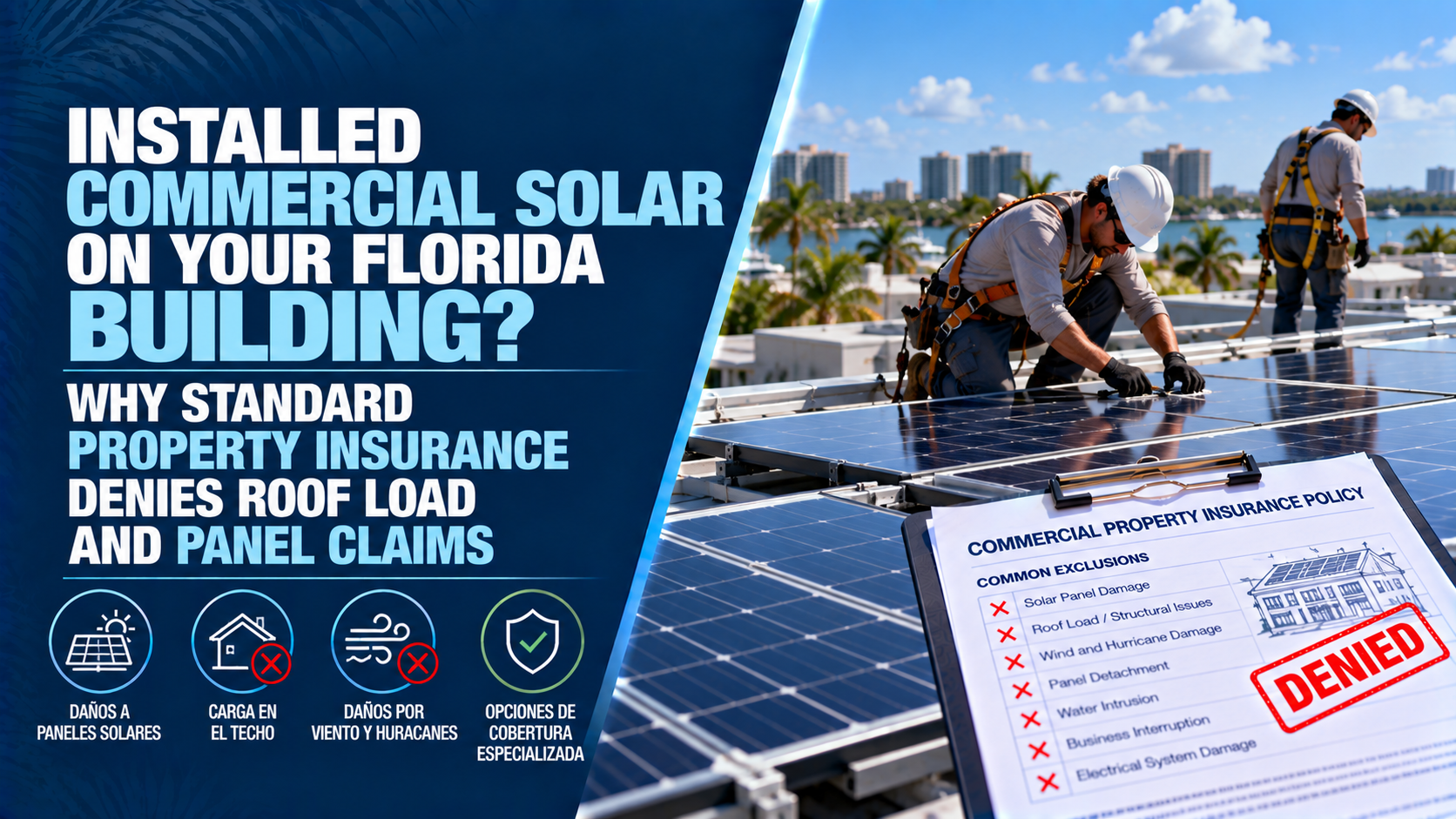
Florida Commercial Solar Insurance: Roof Load & Panel Claims
Installed commercial solar in Florida? Learn why standard property insurance denies roof load, wind uplift, and panel claims, and how to stay protected.
Read More →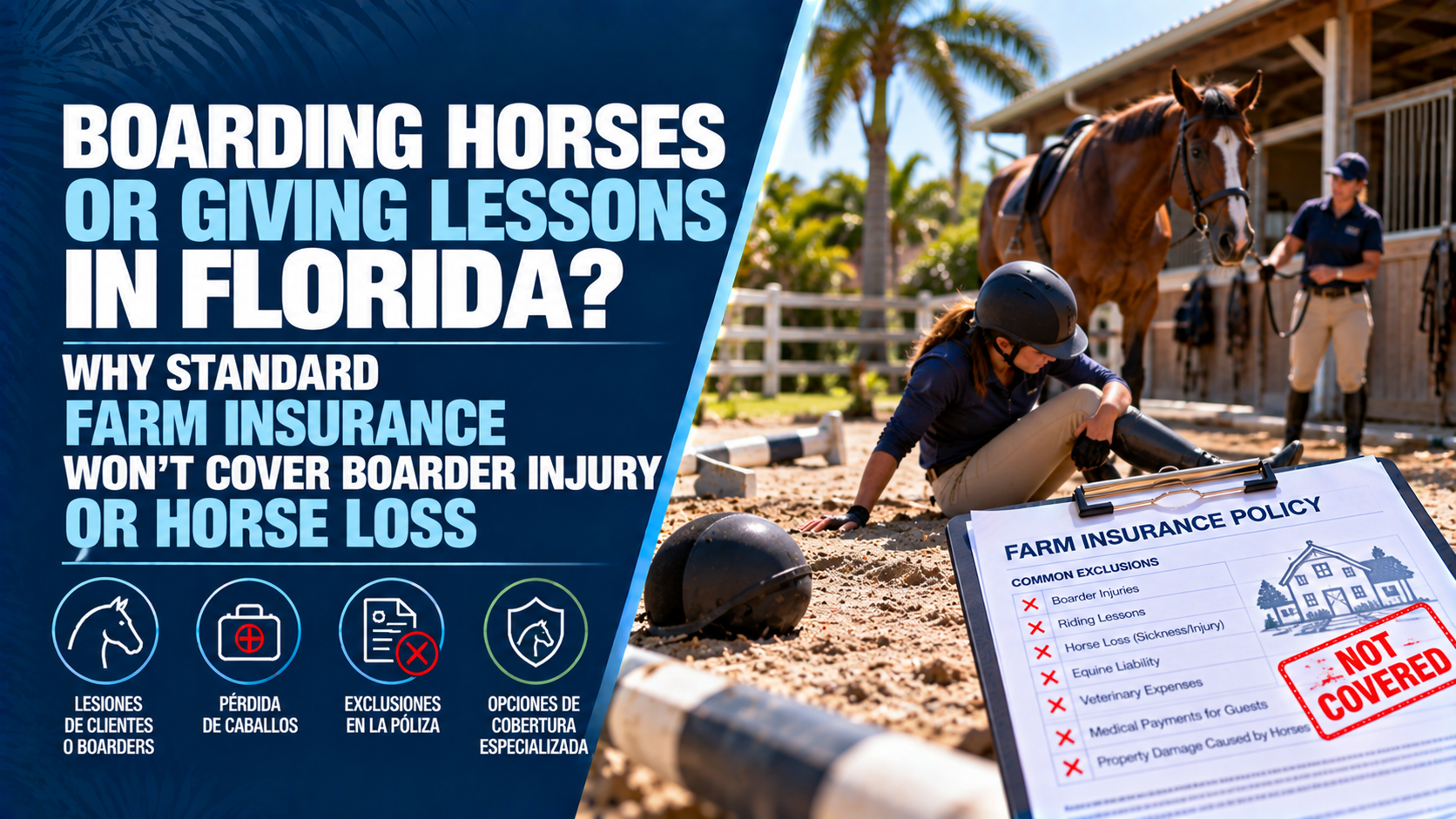
Horse Boarding Insurance in Florida: Boarder Injury & Horse Loss
Boarding horses or giving riding lessons in Florida? Learn why standard farm insurance may not cover boarder injuries, horse losses, or equine liability.
Read More →